Planning a trip together is exciting, but managing shared expenses can sometimes become complicated. A well-organized couples travel budget helps partners estimate the total cost of a vacation, track individual spending, and decide how to divide expenses fairly. Whether you are planning a weekend getaway, an international vacation, or a longer road trip, having a clear financial plan can make the experience more enjoyable.
Unlike an individual travel budget, a couples vacation budget needs to account for two people. You need to consider not only how much the trip will cost but also who pays for each expense, how shared costs are divided, and whether one partner has spent more than the other.
A printable couples travel budget worksheet makes this process easier by organizing trip expenses, planned costs, actual spending, and payment contributions in one place. In this guide, you will learn how to create a realistic travel budget, split expenses fairly, track spending, and use a printable template to organize your next vacation together.
What Is a Couples Travel Budget?
A couples travel budget is a financial plan that outlines the expected and actual expenses of a trip taken by two people. It helps partners understand the total vacation cost, establish spending limits, and organize how expenses will be shared.
Common travel expenses include transportation, accommodation, meals, activities, local transportation, travel insurance, and shopping. Depending on the destination and length of the trip, additional expenses may also need to be considered.
A good budget should track two important things:
- Overall trip expenses: How much the vacation is expected to cost and how much has actually been spent.
- Individual contributions: Who paid for each expense and how much each partner contributed toward the total cost.
Keeping both details organized helps prevent misunderstandings and makes it easier to manage shared vacation expenses.
Why Should Couples Create a Travel Budget?
Creating a travel budget before leaving home can help couples make better financial decisions and avoid unnecessary stress during their vacation.
1. Avoid Unexpected Travel Expenses
Travel costs can quickly increase when meals, transportation, activities, and additional purchases are not planned in advance. A budget helps identify these expenses before they become financial surprises.
By estimating costs for each category, couples can prepare a more realistic spending limit and leave room for unexpected situations.
2. Make Expense Sharing Easier
When two people travel together, they may pay for different expenses at different times. One partner might book the hotel, while the other pays for meals, transportation, or activities.
Tracking individual payments makes it easier to understand each person’s contribution and determine whether expenses are being shared according to the agreed arrangement.
3. Set Financial Priorities Together
One partner may prefer spending more on comfortable accommodation, while the other may prioritize sightseeing, restaurants, or special experiences.
A shared budget creates an opportunity to discuss these preferences before making reservations. It helps both partners agree on what matters most during the trip.
4. Stay Within Your Spending Limit
A travel budget gives couples a clear financial target. You can compare planned expenses with actual spending throughout the vacation and make adjustments when necessary.
This approach helps prevent small purchases from gradually turning into a much larger expense than expected.
What Expenses Should Be Included in a Couples Travel Budget?
Before creating a vacation budget, identify the main expense categories you expect to encounter. Including both major and smaller costs will give you a more accurate picture of your total travel expenses.
1. Flights and Transportation
Transportation is often one of the largest travel expenses. Depending on your destination, this category may include:
- Round-trip airline tickets.
- Train or bus tickets.
- Car rentals.
- Fuel and toll charges.
- Airport transfers and parking fees.
2. Accommodation
Accommodation costs should include the full amount you expect to pay for your stay. Consider hotels, vacation rentals, resorts, or other lodging options.
Remember to check whether additional charges apply, such as cleaning fees, resort fees, deposits, or local accommodation taxes.
3. Food and Drinks
Meals can represent a significant portion of a vacation budget, especially when traveling for several days.
Estimate daily spending for breakfast, lunch, dinner, snacks, coffee, and drinks. You can also decide in advance whether you prefer restaurant meals, casual dining, or preparing some meals yourself.
4. Activities and Tours
Include the cost of attractions, guided tours, entertainment, museum tickets, outdoor activities, and other experiences you plan to enjoy together.
Some activities require advance reservations, so check prices and availability before finalizing your budget.
5. Local Transportation
Getting around your destination may involve public transportation, taxis, rideshare services, rental vehicles, or bicycle rentals.
Estimate these costs based on the distance between your accommodation and the places you intend to visit.
6. Shopping and Souvenirs
Many couples enjoy purchasing souvenirs, gifts, clothing, or local products during their travels. Setting aside a separate shopping allowance can help prevent these purchases from affecting essential expenses.
7. Travel Insurance
Depending on your destination and travel arrangements, insurance may help protect against certain unexpected events. Compare coverage, exclusions, and policy costs before purchasing a plan.
8. Emergency and Miscellaneous Expenses
It is helpful to reserve part of your budget for unexpected costs. These may include additional transportation, minor medical expenses, schedule changes, or other unplanned purchases.
An emergency allowance gives you more flexibility without disrupting the rest of your vacation budget.
How to Create a Couples Travel Budget
Creating a shared vacation budget does not need to be complicated. Follow these steps to organize your finances before booking your trip.
Step 1: Decide on Your Total Travel Budget
Start by discussing how much you and your partner are comfortable spending. Consider your available savings, regular financial commitments, and other upcoming expenses.
Choose a realistic maximum amount that both partners agree on. Your travel budget should support your vacation plans without putting unnecessary pressure on your everyday finances.
Step 2: Choose Your Destination and Travel Dates
Your destination and travel dates will influence the overall cost of the trip. Research accommodation prices, transportation options, seasonal rates, and local living expenses.
Traveling during peak holiday periods may cost more than visiting during quieter months. Flexible dates can sometimes provide opportunities to reduce expenses.
Step 3: Estimate Expenses by Category
List the major expenses you expect to pay for during the trip. Assign an estimated amount to each category, including transportation, accommodation, meals, activities, and miscellaneous costs.
Be realistic when estimating expenses. Research actual prices instead of relying entirely on guesses.
Step 4: Decide How to Split Travel Expenses
Before the trip begins, discuss how you want to divide shared expenses. There is no single method that works for every couple, so choose an arrangement that feels fair to both partners.
Common expense-sharing methods include:
- Equal split: Both partners contribute 50% of shared expenses.
- Income-based split: Each partner contributes according to an agreed percentage of their income.
- Category-based split: One partner pays for certain categories while the other handles different expenses.
- Individual payment tracking: Both partners pay for different items and record their contributions to calculate the final balance.
Discuss the arrangement before making major reservations. Clear expectations can help avoid disagreements about money during the vacation.
Step 5: Record Who Pays for Each Expense
Keep track of individual payments whenever you book accommodation, purchase tickets, pay for meals, or arrange activities.
Record the amount, expense category, payment date, and person who paid. This information makes it easier to calculate each partner’s contribution later.
Step 6: Compare Planned and Actual Spending
Once the trip begins, update your budget whenever you make a purchase. Compare the actual amount with your original estimate to see whether you are staying within your spending limit.
If one category becomes more expensive than expected, consider reducing spending in another category.
Step 7: Calculate the Final Expense Balance
After the trip, calculate the total amount paid by each partner and compare it with your agreed sharing arrangement.
If you agreed to split shared expenses equally, the partner who contributed less may need to reimburse the other for the difference. A clear payment record makes this calculation much easier.
How to Split Travel Expenses Fairly as a Couple
Sharing travel expenses fairly does not always mean dividing every purchase equally. The best approach depends on each partner’s financial situation, preferences, and existing agreements.
Option 1: Split Everything 50/50
This is one of the simplest methods. Both partners contribute the same amount toward shared vacation expenses.
For example, if the total shared expenses are $2,000, each partner contributes $1,000.
This arrangement works well when both partners have similar financial circumstances and prefer an equal contribution.
Option 2: Split Expenses Based on Income
Some couples prefer to contribute according to their individual incomes. This approach can make shared expenses more manageable when there is a significant difference in earnings.
For example, if one partner earns 60% of the couple’s combined income and the other earns 40%, they may agree to divide shared travel costs using the same percentages.
For $2,000 in shared expenses, the contributions would be $1,200 and $800.
Option 3: Divide Expenses by Category
Another approach is to assign different expense categories to each partner. One person might pay for accommodation, while the other covers transportation and meals.
This method can be convenient, but both partners should compare their contributions regularly to ensure that the arrangement remains balanced.
Option 4: Track Payments and Settle the Difference
Both partners can pay for expenses whenever necessary and record each payment in a shared worksheet. At the end of the trip, calculate the total contributions and settle any difference according to your agreed sharing arrangement.
This method offers flexibility and works particularly well when expenses are paid using different accounts or payment methods.
Couples Travel Budget Example
Here is a sample budget for a five-day vacation for two people. The figures are illustrative and should be adjusted according to your destination, travel dates, and preferences.
- Flights and transportation: $500
- Accommodation: $600
- Food and drinks: $300
- Activities and tours: $200
- Local transportation: $100
- Shopping and souvenirs: $100
- Travel insurance: $50
- Emergency allowance: $150
Total estimated travel budget: $2,000
If both partners agree to split the expenses equally, each person would be responsible for $1,000.
However, suppose one partner pays $1,300 during the trip and the other pays $700. The total is still $2,000, but the contributions are not equal.
To achieve a 50/50 split, the second partner would need to reimburse the first partner $300. After the adjustment, both partners would have contributed $1,000.
This simple example shows why tracking who paid for each expense is just as important as tracking the overall trip cost.
Free Couples Travel Budget Printable Template
Organizing a shared vacation budget is easier when all financial details are recorded in one place. A printable couples travel budget template provides a convenient way to estimate costs, track actual spending, and monitor each partner’s contribution.
Instead of keeping separate notes or trying to remember who paid for different purchases, you can use a single worksheet to organize your travel finances.
The printable template below includes dedicated sections for trip information, budget summaries, expense categories, individual payment tracking, and notes or reminders.
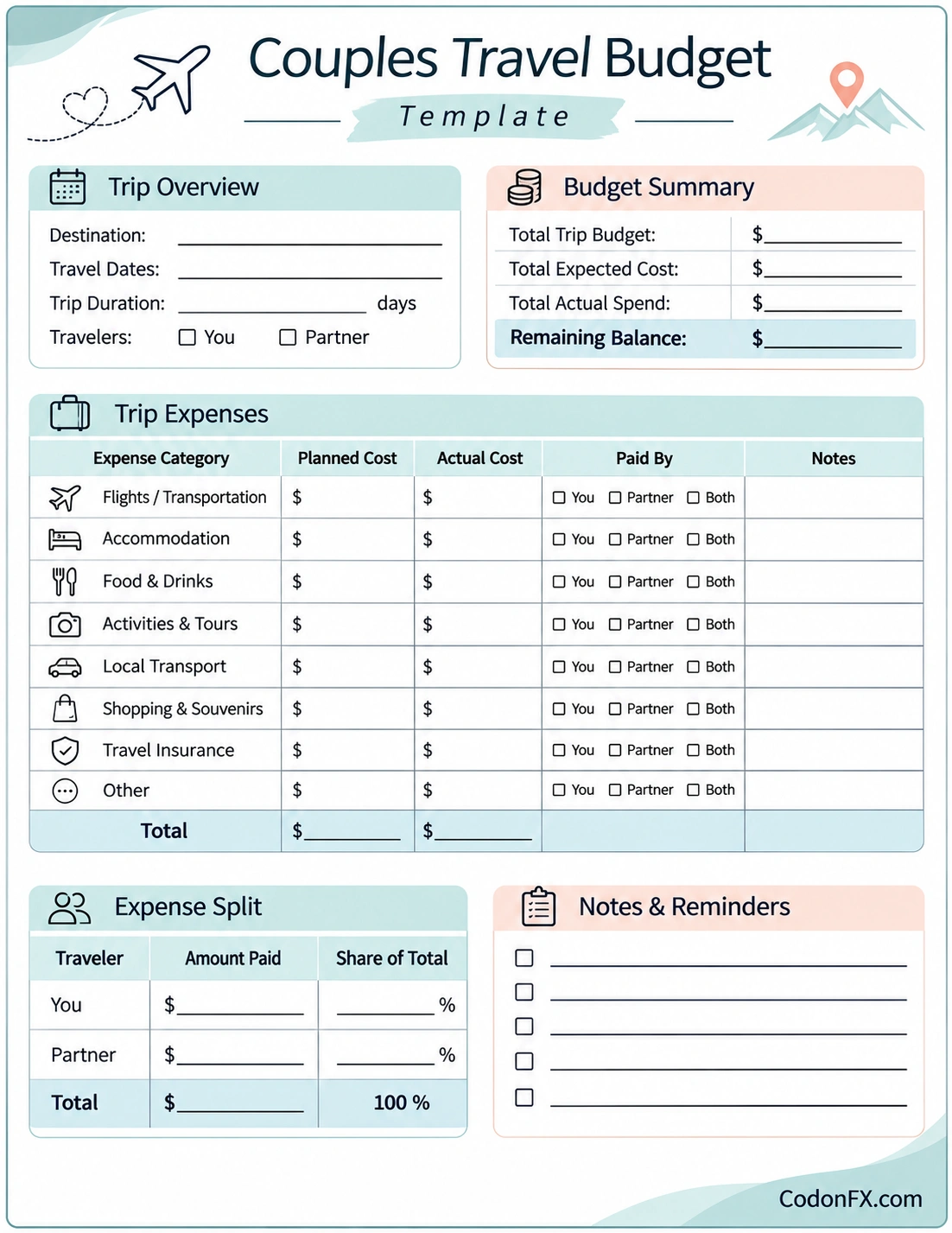
The worksheet uses a US Letter portrait layout (8.5 x 11 inches), making it suitable for standard home and office printers.
To use the template, enter your destination and travel dates, set your total budget, and estimate expenses for each category. During the trip, update the actual costs and mark whether each expense was paid by you, your partner, or both.
At the end of your vacation, use the expense split section to review each person’s contribution and calculate any remaining amount that needs to be settled.
Tips for Managing Money During a Couples Vacation
A good budget is only useful when both partners follow it. These practical tips can help you manage shared expenses throughout your trip.
Discuss Financial Expectations Before Traveling
Talk about spending preferences, accommodation standards, dining choices, and activities before making reservations. Agreeing on financial expectations early can prevent misunderstandings later.
Keep a Shared Expense Record
Update your worksheet whenever one of you makes a shared purchase. Recording payments immediately is more reliable than trying to remember every transaction at the end of the day.
Separate Shared and Personal Expenses
Not every vacation purchase needs to be divided equally. Personal shopping, individual hobbies, and other private purchases can be tracked separately from shared expenses.
Leave Room for Unexpected Costs
Avoid spending your entire budget on planned activities and reservations. Keeping a reasonable contingency amount provides flexibility when travel plans change.
Review Your Spending Together
Take a few minutes each day to review your expenses. This allows both partners to see how much has been spent and whether any adjustments are necessary.
Choose a Payment Method That Works for Both Partners
Some couples prefer a shared travel account, while others use separate cards or payment methods. Choose an arrangement that is convenient, transparent, and comfortable for both people.
Frequently Asked Questions About Couples Travel Budgets
What is a couples travel budget?
A couples travel budget is a financial plan that helps two people organize the total cost of a vacation and track how much each person contributes. It typically includes transportation, accommodation, meals, activities, and other travel expenses.
How do couples split travel expenses?
Couples can divide travel expenses equally, contribute according to income, assign different expense categories to each person, or track individual payments and settle the difference afterward. The best method depends on their financial circumstances and mutual agreement.
Should couples split vacation costs 50/50?
A 50/50 split is a simple option, but it is not the only fair arrangement. Couples with different incomes may prefer proportional contributions, while others may divide expenses by category. Both partners should agree on the method before traveling.
What should be included in a couples vacation budget?
A couples vacation budget should include flights, transportation, accommodation, food, drinks, activities, insurance, shopping, and emergency expenses. It should also track who paid for each shared expense.
How do I calculate who owes whom after a trip?
Add up the shared expenses, calculate each partner’s agreed share, and compare that amount with what each person actually paid. The partner who contributed less can reimburse the difference to balance the agreed contributions.
Can couples use a spreadsheet to track travel expenses?
Yes. Excel and Google Sheets are useful for tracking planned costs, actual expenses, payment contributions, and remaining balances. A printable worksheet is another convenient option for couples who prefer recording expenses by hand.
How much should couples budget for a vacation?
The amount depends on the destination, trip duration, transportation, accommodation preferences, and planned activities. Couples should research current prices and choose a spending limit that fits their available finances.
Should personal purchases be included in a shared travel budget?
Personal purchases can be recorded separately from shared expenses. For example, individual clothing, souvenirs, or personal activities do not necessarily need to be divided between both partners.
Why is tracking who paid for each expense important?
Payment tracking provides a clear record of each person’s contribution. It helps couples calculate shared costs accurately, avoid confusion, and settle outstanding balances fairly.
Can I use a printable couples travel budget template?
Yes. A printable template can help you organize trip details, estimate expenses, compare planned and actual costs, and track individual payments. It is particularly useful when both partners want a simple overview of their vacation finances.
Plan Your Next Vacation Together with Confidence
A well-organized couples travel budget helps partners manage vacation expenses while maintaining a clear understanding of who pays for what. By estimating costs, agreeing on an expense-sharing method, and tracking individual contributions, couples can avoid unnecessary financial confusion.
Whether you are planning a short weekend getaway or an international vacation, taking time to organize your finances can make the entire experience more enjoyable.
Use a printable couples travel budget template to record your trip expenses, compare planned and actual spending, and calculate each partner’s share. With a shared financial plan and open communication, you can spend less time worrying about money and more time enjoying your trip together.
Download: Couples Travel Budget Template
