Taking effective notes is an important part of learning, but simply writing down everything you hear or read does not always lead to better understanding. Students often struggle to organize information, identify important concepts, and remember what they have learned. Cornell Notes offer a structured solution by turning ordinary note-taking into an active learning process.
The Cornell Notes method is a note-taking system that divides a page into three main sections: a notes area, a cue column, and a summary section. Each section serves a different purpose, helping students record information, identify key questions, and review important concepts more effectively.
Originally developed by Walter Pauk at Cornell University, this method has become a popular study technique for students, teachers, and professionals. It can be used in classrooms, college lectures, textbook reading, online courses, and independent study.
In this guide, you will learn what Cornell Notes are, how the system works, how to organize each section, and how to use the method to improve your study routine. You will also find practical examples, helpful tips, and a printable Cornell Notes template.
What Are Cornell Notes?
Cornell Notes are a structured note-taking method designed to help learners organize, understand, and review information. The system uses a specially divided page that separates detailed notes from key questions and a short summary.
Unlike traditional note-taking, which often involves writing information continuously from top to bottom, the Cornell method encourages students to process information in different ways. They record important details, create questions based on those details, and summarize the main ideas in their own words.
The system was developed by Walter Pauk, an education professor at Cornell University, to help students improve their learning and study habits. Its simple layout makes it suitable for different subjects and educational levels.
A standard Cornell Notes page contains three main areas:
- Notes column: The large right-hand section used to record important information during a lecture or reading session.
- Cue column: The narrower left-hand section used for keywords, questions, definitions, and memory prompts.
- Summary section: The bottom section used to explain the main ideas in a few sentences.
How Does the Cornell Notes Method Work?
The Cornell note-taking system follows a simple process that encourages active participation before, during, and after a learning session. Each stage helps students organize information and prepare it for later review.
1. Prepare the Notes Page
Before starting a lecture or reading assignment, divide your paper into three sections. Leave a large area on the right for notes, a smaller column on the left for cues, and a horizontal section at the bottom for the summary.
Write the subject, topic, and date at the top of the page. This makes it easier to organize and find your notes later.
2. Record Important Information
During a lecture or reading session, use the main notes column to capture important information. Focus on key concepts, explanations, examples, definitions, and supporting details rather than copying every word.
Use short phrases, abbreviations, bullet points, and simple diagrams when appropriate. Organizing information in your own words can make it easier to understand and remember.
3. Create Questions and Cues
After the learning session, review your notes and identify the most important ideas. Write related questions, keywords, or short prompts in the left-hand cue column.
For example, if your notes explain the causes of climate change, you could write questions such as:
- What are the main causes of climate change?
- How do greenhouse gases affect the atmosphere?
- What are the consequences of global warming?
These prompts help turn your notes into a self-testing tool.
4. Write a Short Summary
Use the bottom section to summarize the information on the page. Explain the main ideas in a few clear sentences using your own words.
A good summary should highlight the most important concepts without repeating every detail from the notes column. This step encourages you to identify what you have learned and how the information connects.
5. Review and Test Yourself
Cover the main notes column and use the questions in the cue column to test your understanding. Try answering each question without looking at the detailed notes.
Afterward, uncover the notes and check your answers. Review any concepts that you could not explain clearly. Repeating this process over time can strengthen recall and help identify areas that need additional attention.
Cornell Notes Template: Example and Layout
A well-organized Cornell Notes template makes it easier to follow the method consistently. The traditional layout uses a large section for detailed notes, a smaller cue column for questions, and a summary area at the bottom.
Below is a printable Cornell Notes worksheet designed for students, teachers, and anyone who wants to organize information more effectively.
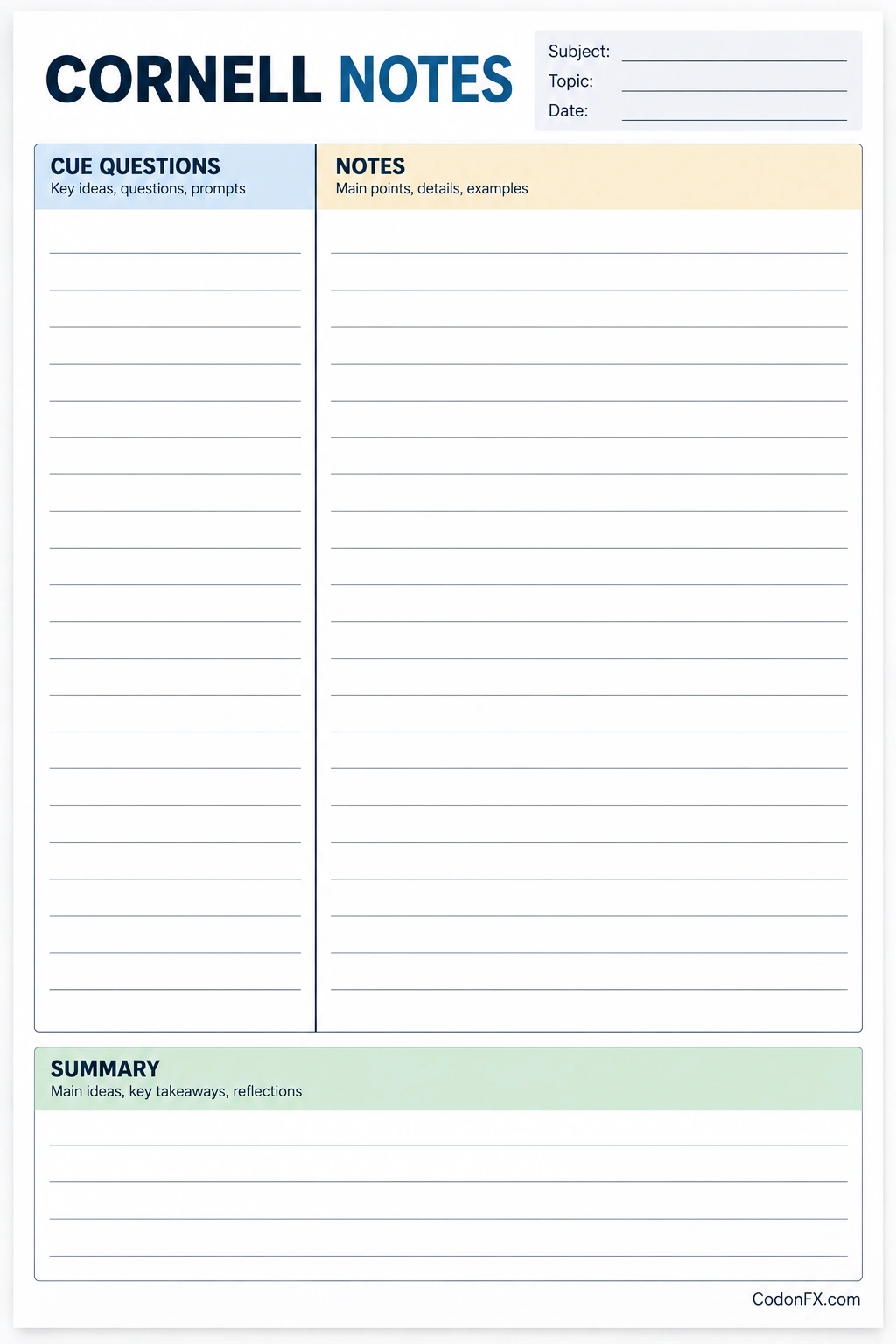
The template includes dedicated spaces for the subject, topic, and date at the top. The main section is divided into a narrow cue column and a wider notes column, allowing students to organize questions alongside their detailed notes.
The summary section at the bottom provides space to review the most important information in a concise format. This layout can be used for classroom lectures, textbook chapters, research, and independent study.
Benefits of Using Cornell Notes
The Cornell method offers several advantages for students and other learners. Its structured format encourages active engagement with information instead of relying only on passive reading or copying.
1. Improves Information Organization
The three-section layout separates detailed information, important questions, and summaries. This makes notes easier to read, understand, and review.
2. Encourages Active Learning
Creating questions and summarizing information requires learners to think about what they have studied. This encourages deeper engagement with the material.
3. Supports Better Recall
The cue column provides useful prompts for self-testing. Instead of simply rereading notes, students can actively retrieve information from memory and identify concepts they need to review.
4. Makes Reviewing Easier
Because key questions and summaries are separated from detailed notes, students can quickly identify important concepts without reading the entire page again.
5. Saves Study Time
Organized notes can make exam preparation and assignment review more efficient. Students can focus on important questions, key definitions, and major concepts rather than searching through unstructured information.
6. Works Across Different Subjects
The Cornell method is flexible enough for subjects such as science, mathematics, history, literature, business, and social studies. The layout can also be adapted for professional training and meeting notes.
Tips for Taking Better Cornell Notes
Although the Cornell system is straightforward, using it effectively requires consistent habits. These practical tips can help you get more value from each study session.
- Focus on important ideas: Record key concepts rather than trying to write down every sentence from a lecture.
- Use your own words: Rephrase information to demonstrate understanding instead of copying long passages.
- Keep notes organized: Use headings, bullet points, abbreviations, and spacing to make information easier to follow.
- Write meaningful questions: Create questions that test understanding rather than simply repeating individual words.
- Complete the summary promptly: Summarize the material while the information is still fresh in your mind.
- Review regularly: Set aside time to answer cue questions and revisit difficult concepts.
- Stay consistent: Use the same basic layout across different subjects to develop a reliable study routine.
Common Cornell Notes Mistakes to Avoid
Some students use the Cornell layout but do not fully follow the learning process behind it. Avoid these common mistakes to make your notes more useful.
Writing Too Much Information
Trying to record every word can make notes difficult to review. Focus on essential concepts, supporting details, and examples instead.
Leaving the Cue Column Empty
The cue column is an important part of the method. Without questions or prompts, you lose an opportunity to test your understanding and practice active recall.
Skipping the Summary Section
Writing a summary helps you identify the main ideas and connect related concepts. Do not leave this section blank simply because the detailed notes already contain the information.
Never Reviewing Your Notes
Creating organized notes is only part of the process. Regular review and self-testing are necessary to make the system useful as a long-term study strategy.
Cornell Notes vs. Traditional Note-Taking
Both Cornell Notes and traditional note-taking can help students record information, but they organize material differently.
Cornell Notes
The Cornell method uses a structured layout with separate areas for detailed notes, cue questions, and summaries. It encourages learners to review and test their understanding after recording information.
Traditional Note-Taking
Traditional note-taking usually involves recording information in a continuous format. Students may use headings, paragraphs, bullet points, or outlines, but there is not necessarily a dedicated section for review questions or summaries.
The main difference is that Cornell Notes combine information recording with a built-in review process. Traditional notes can still be effective, but they may require additional steps to support active recall and organized revision.
Who Should Use Cornell Notes?
The Cornell method is suitable for different types of learners because its layout can be adapted to various learning situations.
- High school students: Organize classroom lectures, textbook information, and exam preparation materials.
- College students: Manage detailed lecture notes, academic readings, and complex course concepts.
- Teachers: Prepare structured lesson notes and organize important teaching information.
- Independent learners: Record key ideas from books, online courses, tutorials, and educational videos.
- Professionals: Organize information from training sessions, workshops, seminars, and meetings.
Frequently Asked Questions About Cornell Notes
What are the three parts of Cornell Notes?
The three main parts are the notes column, cue column, and summary section. The notes column contains detailed information, the cue column holds questions and keywords, and the summary section highlights the main ideas.
Who invented the Cornell Notes method?
The Cornell Notes method was developed by Walter Pauk, an education professor at Cornell University. He introduced the system to help students organize information and develop more effective study habits.
How do you set up a Cornell Notes page?
Divide a page into a large notes area on the right, a narrower cue column on the left, and a summary section across the bottom. Add the subject, topic, and date at the top.
What should go in the cue column?
The cue column should contain questions, keywords, definitions, and short prompts related to the detailed notes. These cues help students review information and test their memory.
What should be included in a Cornell Notes summary?
A Cornell Notes summary should explain the main ideas and important takeaways from the page in a few sentences. Use your own words and focus on the most meaningful information.
Are Cornell Notes effective for studying?
Cornell Notes can support effective studying because they encourage organized note-taking, self-questioning, summarization, and active recall. However, their effectiveness also depends on how consistently students review and use their notes.
Can I use Cornell Notes for any subject?
Yes. The method can be adapted for subjects such as mathematics, science, history, literature, business, and many others. You can adjust the notes and cue sections to match the type of information being studied.
How often should I review Cornell Notes?
Review your notes shortly after the learning session and revisit them regularly. You can use a spaced review schedule, such as reviewing the material the next day, several days later, and again before an exam.
Can I use Cornell Notes digitally?
Yes. You can create a digital Cornell Notes layout using word processors, note-taking applications, or digital notebooks. The important part is maintaining the three-section structure and following the review process.
Are Cornell Notes better than traditional notes?
Neither method is automatically better for every learner or subject. Cornell Notes provide a structured review system, while traditional notes offer more flexibility. The best approach depends on your learning preferences and the type of information you need to organize.
Conclusion
Cornell Notes provide a practical and organized way to record, understand, and review information. By dividing a page into notes, cue questions, and summary sections, the method encourages learners to engage with material beyond simply writing it down.
Whether you are preparing for exams, attending lectures, reading textbooks, or learning independently, this note-taking system can help you organize important concepts and develop more effective study habits.
For the best results, focus on recording meaningful information, creating useful review questions, writing concise summaries, and revisiting your notes regularly. With consistent practice, Cornell Notes can become a valuable part of your everyday learning routine.
Download: Cornell Notes Template
