Every organization encounters problems that can affect productivity, quality, safety, and overall performance. When an issue occurs, simply fixing the immediate problem may not be enough. Businesses need a structured approach to identify what went wrong, determine why it happened, and prevent the same issue from happening again. A Corrective Action Plan provides a practical way to achieve these goals.
Whether you manage a small business, lead a department, supervise employees, or oversee quality management, a corrective action plan helps turn problems into opportunities for improvement. It establishes clear responsibilities, defines specific solutions, and sets deadlines for completing necessary actions.
In this guide, you will learn what a corrective action plan is, why organizations use it, and how to create an effective action plan. You will also find practical examples, essential components, and a free printable Corrective Action Plan Template to help organize your improvement process.
What Is a Corrective Action Plan?
A Corrective Action Plan (CAP) is a structured document that outlines the steps an organization will take to identify, investigate, resolve, and prevent the recurrence of a problem. It helps businesses address nonconformities, operational failures, performance issues, and other situations that require improvement.
The main purpose of a corrective action plan is to address the root cause of an issue rather than only correcting its immediate symptoms. By understanding why a problem occurred, organizations can develop solutions that improve processes and reduce the risk of similar incidents.
A typical corrective action plan identifies the problem, analyzes its root cause, assigns corrective actions, establishes deadlines, and defines how results will be measured and verified.
Organizations use corrective action plans in many areas, including:
- Quality management and manufacturing.
- Workplace safety and compliance.
- Employee performance management.
- Customer service and complaint resolution.
- Project management and business operations.
- Healthcare and administrative processes.
- Education and organizational improvement.
Although the details may vary, the objective remains the same: resolve identified problems and establish measures that help prevent them from happening again.
Why Is a Corrective Action Plan Important?
A corrective action plan helps organizations respond to problems systematically instead of relying on temporary fixes. It also makes the improvement process easier to monitor because every action has an assigned owner and a clear deadline.
Here are some important benefits of using a corrective action plan:
- Identifies root causes: It encourages organizations to investigate the underlying reasons behind problems instead of treating symptoms alone.
- Improves operational efficiency: Correcting ineffective processes can reduce delays, waste, errors, and unnecessary work.
- Prevents recurring problems: Preventive measures help reduce the likelihood of similar issues happening again.
- Clarifies responsibilities: Each action can be assigned to a specific employee, department, or team.
- Supports compliance: Documented actions can help organizations address audit findings, internal requirements, and applicable regulations.
- Improves accountability: Deadlines and progress updates make it easier to track whether corrective actions are completed.
- Encourages continuous improvement: Organizations can use findings from previous problems to strengthen their processes.
Without a clear action plan, problems may remain unresolved or return because their underlying causes were never properly addressed.
What Are the Main Components of a Corrective Action Plan?
An effective corrective action plan should contain enough information to explain the problem, document the investigation, and track the implementation of solutions. The following components provide a practical structure.
1. Problem or Issue Description
Start by describing the problem that needs to be addressed. Include relevant details such as what happened, when it occurred, where it was identified, and how it affected operations.
A clear problem statement helps everyone understand the issue and prevents confusion during the investigation.
For example, a manufacturing company may identify that several products failed a quality inspection because of inconsistent measurements during production.
2. Root Cause Analysis
Root cause analysis identifies the underlying factors that contributed to the problem. Instead of assuming that the first visible explanation is the actual cause, investigate the process and supporting evidence.
Common root cause analysis methods include:
- 5 Whys Analysis: Ask why the problem occurred repeatedly until the underlying cause becomes clearer.
- Fishbone Diagram: Organize potential causes into categories such as people, methods, materials, equipment, and environment.
- Process Analysis: Review the steps involved in a process to identify weaknesses or failures.
- Data Analysis: Examine records, measurements, reports, and trends to identify contributing factors.
A reliable root cause analysis should be supported by evidence rather than assumptions or personal opinions.
3. Corrective Actions
Corrective actions are the specific steps taken to eliminate or address the identified root cause. These actions should directly relate to the problem and be realistic for the organization to implement.
Examples include:
- Repairing or replacing defective equipment.
- Updating an outdated operating procedure.
- Providing additional employee training.
- Improving quality inspection procedures.
- Changing an ineffective workflow.
- Introducing additional process controls.
Each corrective action should have a clear expected outcome so that its effectiveness can be evaluated later.
4. Preventive Actions
Preventive actions are measures designed to reduce the risk of similar problems occurring in the future. They strengthen the process and address potential weaknesses beyond the immediate incident.
For example, after discovering repeated data entry errors, an organization might introduce automated validation, improve employee training, and establish periodic record reviews.
Corrective and preventive actions are related but have different purposes. Corrective actions address an identified problem and its cause, while preventive measures help reduce the likelihood of future problems.
5. Action Plan and Responsibilities
This section converts proposed solutions into specific tasks. Every action should have an assigned responsible person, a start date, a due date, and a progress status.
A useful action tracking table includes:
- Action item or task description.
- Responsible person or department.
- Start date.
- Completion deadline.
- Current status.
- Additional notes or supporting information.
Assigning ownership prevents important tasks from being overlooked and makes progress easier to monitor.
6. Expected Results
Define what successful implementation should look like. Expected results should be specific enough to evaluate whether the corrective action has solved the problem.
For example, a company may expect production defects to decrease, customer complaints to decline, or inspection accuracy to improve after implementing the proposed changes.
7. Follow-Up and Verification
Completing an action does not automatically mean the problem has been resolved. Organizations should verify whether the implemented solution addresses the root cause and produces the intended results.
Follow-up activities may include reviewing performance data, conducting another inspection, interviewing employees, or monitoring the process over an appropriate period.
If the problem continues, additional investigation or revised corrective actions may be necessary.
Free Corrective Action Plan Template
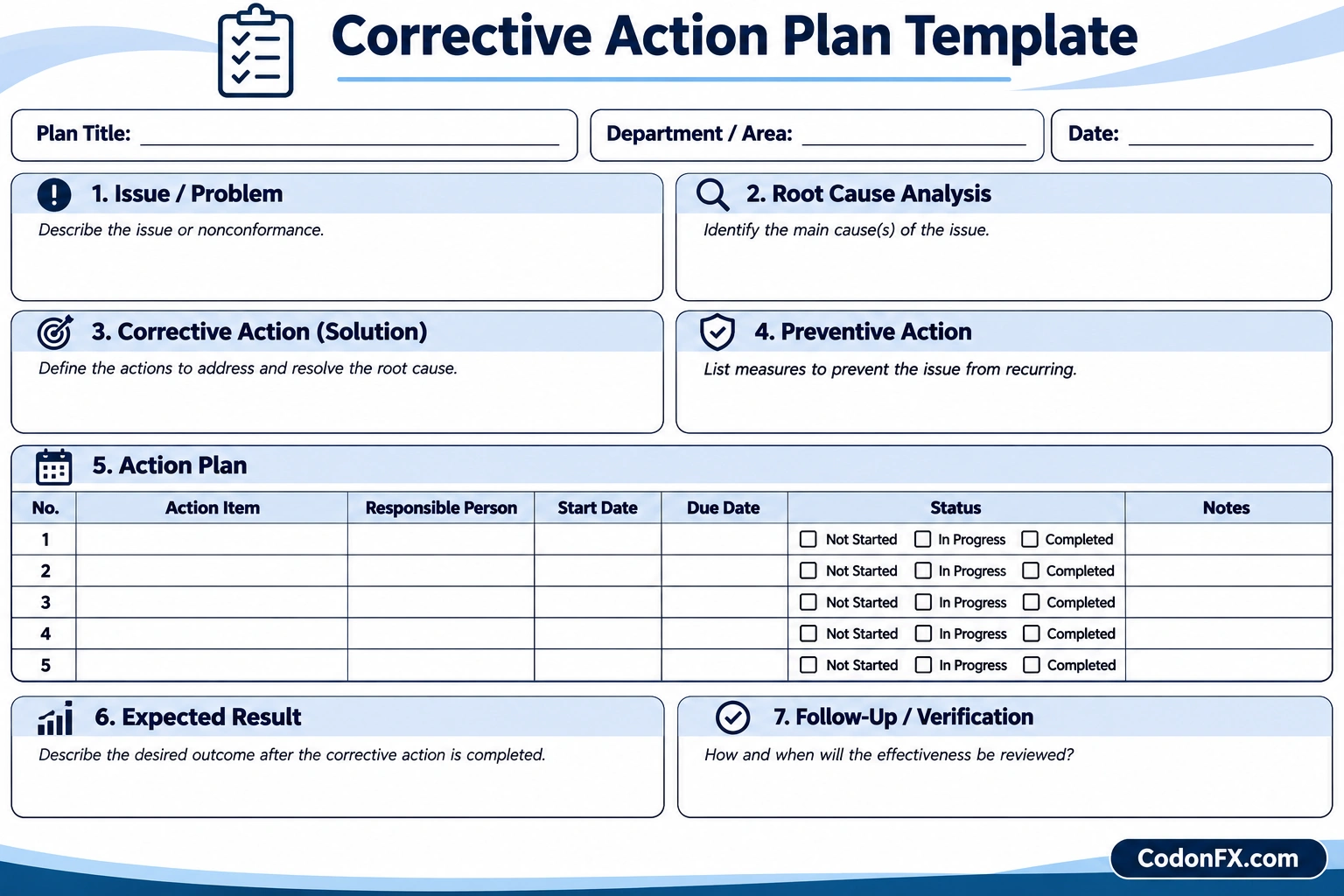
Using a printable corrective action plan template makes it easier to document problems, organize responsibilities, and monitor improvement activities. Instead of creating a new document every time an issue occurs, you can use a consistent worksheet to manage the entire process.
This Corrective Action Plan Template includes dedicated sections for identifying the problem, analyzing root causes, defining corrective and preventive actions, assigning responsibilities, and verifying results.
You can use the worksheet for internal quality reviews, operational improvements, employee-related issues, and other situations that require a documented action plan.
What the template includes:
- Plan title, department, and date.
- Issue or problem description.
- Root cause analysis.
- Corrective action details.
- Preventive action details.
- Action tracking table with responsible persons and deadlines.
- Expected results.
- Follow-up and verification section.
How to Create an Effective Corrective Action Plan
Creating a corrective action plan requires a clear understanding of the problem and a practical approach to resolving it. Follow these steps to develop a structured improvement plan.
Step 1: Identify and Document the Problem
Begin by gathering information about the issue. Describe what happened and document the relevant evidence, including dates, locations, affected processes, and possible consequences.
Avoid vague statements. A specific problem description makes it easier to investigate the issue and determine appropriate solutions.
Step 2: Investigate the Root Cause
Analyze the available information to understand why the problem occurred. Speak with relevant employees, review procedures, examine records, and identify contributing factors.
Use an appropriate root cause analysis method, such as the 5 Whys or a fishbone diagram, to organize your findings.
Step 3: Develop Practical Corrective Actions
Once the root cause is identified, determine which actions can address it effectively. Select solutions that are realistic, measurable, and appropriate for the level of risk involved.
Consider the resources, equipment, training, and management support needed to implement each action.
Step 4: Establish Preventive Measures
Think beyond the immediate problem. Determine whether additional procedures, controls, training, or monitoring activities could reduce the likelihood of recurrence.
Preventive measures should strengthen the process rather than simply add unnecessary administrative tasks.
Step 5: Assign Responsibilities and Deadlines
Assign each action to a person or department with the appropriate authority and resources. Set realistic deadlines and define how progress will be reported.
Clear ownership helps ensure that corrective actions move from planning to implementation.
Step 6: Implement and Monitor the Actions
Carry out the approved tasks according to the action schedule. Monitor progress and document any delays, challenges, or changes that affect implementation.
Managers should review the action plan regularly to ensure that responsibilities remain clear and deadlines are being met.
Step 7: Verify Effectiveness and Close the Plan
After implementation, evaluate whether the corrective actions achieved the intended results. Review relevant performance indicators, inspect the affected process, and confirm that the original problem has been adequately addressed.
Close the corrective action plan only when the required actions are complete and their effectiveness has been verified. If the issue persists, investigate further and revise the plan.
Corrective Action Plan Example
Consider a company that repeatedly receives customer complaints about delayed product deliveries. An investigation reveals that employees are using an outdated order processing procedure, resulting in unnecessary delays.
The company can organize its corrective action plan as follows:
- Problem: Customer orders are frequently delivered later than the promised dates.
- Root Cause: The order processing procedure has not been updated to reflect current operational requirements.
- Corrective Action: Review and update the order processing procedure, then train relevant employees on the revised workflow.
- Preventive Action: Introduce periodic procedure reviews and delivery performance monitoring.
- Responsible Person: Operations Manager.
- Target Completion: Within 30 days.
- Expected Result: Fewer delayed orders and more consistent delivery performance.
- Verification: Review delivery performance data after implementation and compare results with the previous period.
This example demonstrates how a corrective action plan connects an identified problem with its underlying cause, practical solutions, and measurable follow-up activities.
Corrective Action Plan vs. Preventive Action Plan
Corrective action and preventive action are closely related concepts, but they focus on different aspects of process improvement.
Corrective Action Plan
A corrective action plan focuses on resolving an existing problem by identifying and addressing its root cause. It is generally initiated after an issue, failure, or nonconformity has been identified.
Preventive Action Plan
A preventive action plan focuses on reducing the likelihood of potential problems before they occur. It involves identifying risks, evaluating weaknesses, and introducing measures to prevent undesirable outcomes.
In practice, many organizations combine corrective and preventive measures within one improvement process. This approach helps address current issues while strengthening operations against future risks.
Best Practices for Managing Corrective Actions
A well-designed corrective action plan is only effective when it is properly implemented and monitored. These best practices can help organizations achieve better results.
- Focus on root causes: Avoid relying on temporary fixes that do not address the underlying problem.
- Use measurable objectives: Define clear performance indicators to evaluate whether the solution works.
- Involve relevant employees: Include people who understand the affected processes and can provide useful information.
- Set realistic deadlines: Consider available resources and operational priorities when assigning completion dates.
- Maintain proper documentation: Record investigation findings, decisions, completed actions, and verification results.
- Monitor progress consistently: Review open tasks and address implementation delays promptly.
- Verify effectiveness: Confirm that the original issue has been resolved and does not continue to occur.
- Share lessons learned: Communicate relevant improvements so other teams can benefit from the findings.
Remember that a corrective action plan should improve the way an organization operates. It should not become a paperwork exercise that produces documents without meaningful changes.
Common Mistakes to Avoid When Creating a Corrective Action Plan
Some corrective action plans fail because they focus too heavily on documenting tasks rather than solving the actual problem. Avoid these common mistakes:
- Choosing the wrong root cause: Solutions may fail when the investigation identifies symptoms instead of underlying causes.
- Using vague action items: Tasks such as “improve performance” are difficult to measure and verify.
- Failing to assign ownership: Actions without responsible individuals can easily be delayed or forgotten.
- Setting unrealistic deadlines: Insufficient time or resources can prevent successful implementation.
- Ignoring preventive measures: Fixing the current issue without strengthening the process may allow it to happen again.
- Skipping follow-up verification: Closing a plan without checking its effectiveness can leave the original problem unresolved.
Avoiding these mistakes makes the corrective action process more practical, accountable, and results-oriented.
Frequently Asked Questions About Corrective Action Plans
What is the main purpose of a corrective action plan?
The main purpose of a corrective action plan is to identify and resolve the root causes of an existing problem while establishing measures to prevent recurrence. It helps organizations improve processes, maintain standards, and monitor the effectiveness of solutions.
What are the five steps of a corrective action plan?
A simplified five-step process includes identifying the problem, investigating its root cause, developing corrective actions, implementing the solutions, and verifying their effectiveness. Organizations may use additional steps for preventive measures, documentation, and follow-up.
What should be included in a corrective action plan?
A corrective action plan should include a problem description, root cause analysis, corrective actions, preventive measures, responsible persons, deadlines, expected results, and follow-up verification. These components help ensure that every issue is properly investigated and addressed.
What is an example of a corrective action?
An example is updating an outdated operating procedure after discovering that it causes repeated production errors. The organization may revise the procedure, train employees, introduce additional quality checks, and monitor future production results.
Who is responsible for creating a corrective action plan?
Responsibility depends on the organization and the nature of the problem. A department manager, quality assurance professional, supervisor, compliance officer, or designated improvement team may lead the process. Employees involved in the affected process can also contribute to identifying root causes and practical solutions.
What is the difference between corrective action and preventive action?
Corrective action addresses the root cause of an existing problem, while preventive action aims to reduce the likelihood of potential problems occurring. Both support continuous improvement and stronger organizational processes.
How do you measure the effectiveness of corrective actions?
Effectiveness can be measured through performance indicators, inspection results, audit findings, customer feedback, error rates, and other relevant evidence. The organization should compare results with the expected outcomes and confirm that the original problem has been adequately addressed.
When should a corrective action plan be closed?
A corrective action plan should be closed when the assigned actions have been completed, supporting evidence has been documented, and follow-up verification confirms that the solution is effective. If the issue continues, further investigation or additional actions may be required.
Conclusion
A Corrective Action Plan is an essential tool for organizations that want to resolve problems systematically and improve operational performance. By identifying issues, investigating root causes, implementing practical solutions, and verifying results, businesses can address weaknesses and reduce the risk of recurring problems.
A structured template makes this process easier by organizing responsibilities, deadlines, corrective measures, and follow-up activities in one place. Whether you are managing quality issues, workplace procedures, compliance findings, or operational challenges, a clear action plan provides a practical framework for improvement.
Use the printable Corrective Action Plan Template to document your next improvement initiative, track progress, and ensure that every action contributes to a measurable and lasting result.
Download: Corrective Action Plan Template
