A commission agreement is a written contract that explains how a salesperson, agent, representative, or other professional will be compensated for generating sales or business. It establishes important terms such as the commission rate, eligible sales, payment schedule, responsibilities, and the duration of the agreement.
Having these terms in writing can help both parties understand how compensation will be calculated and when commissions will be paid. A clear agreement can also reduce misunderstandings by defining expectations before sales activities begin.
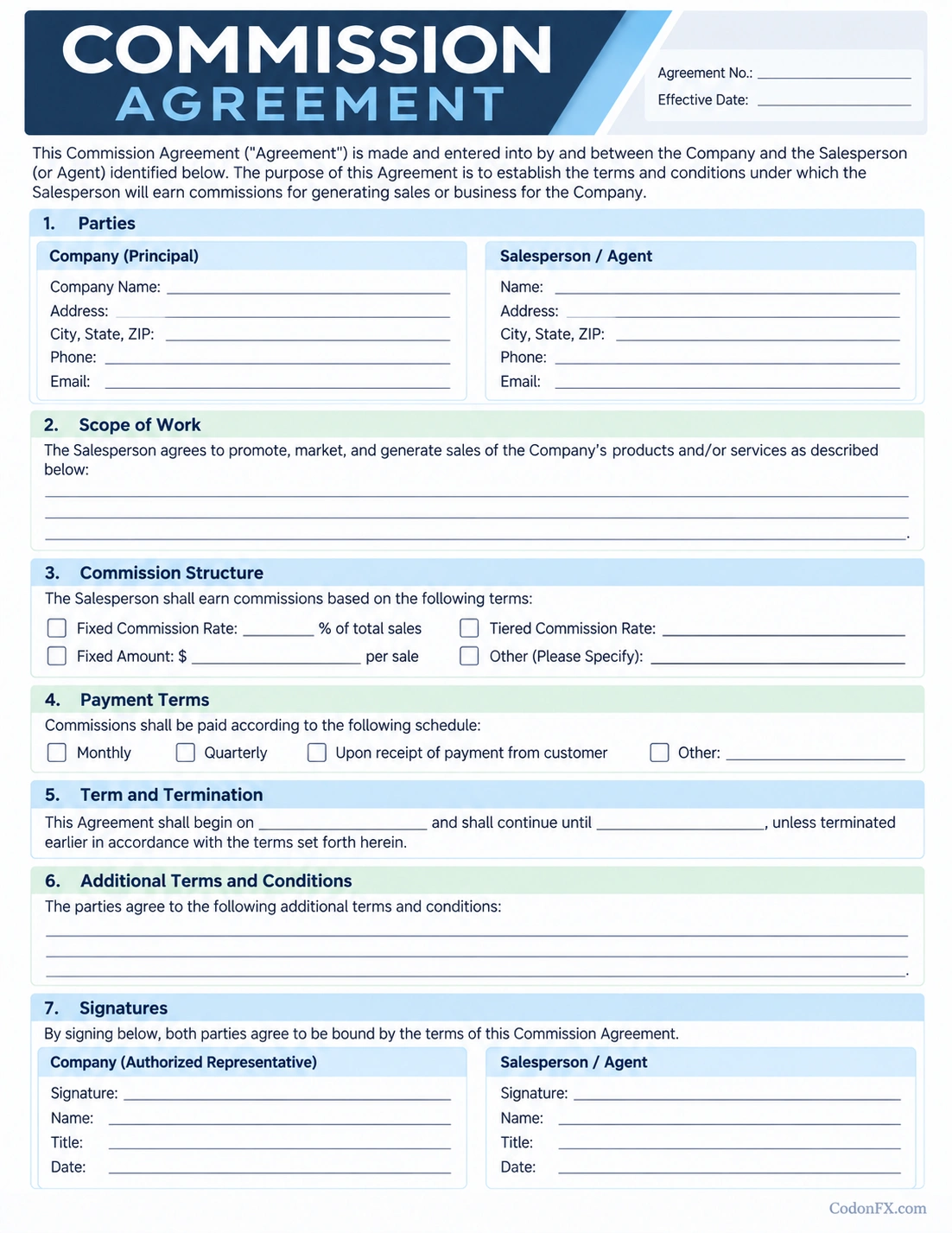
A commission agreement template can provide a practical starting point for documenting the relationship between a company and a salesperson or agent. It can be customized to include the specific commission structure, payment conditions, sales responsibilities, and other terms that apply to the arrangement.
What Is a Commission Agreement?
A commission agreement is a formal agreement between two parties that establishes the conditions under which one party earns compensation for generating sales, customers, leads, or other business opportunities.
The person earning the commission may be a salesperson, independent agent, representative, broker, affiliate, or another professional, depending on the business arrangement.
A commission agreement can specify:
- Who is entitled to commissions
- Which products or services qualify for commissions
- How commissions are calculated
- The applicable commission rate
- When commissions are earned
- When commissions are paid
- How returns, refunds, or canceled orders affect commissions
- The responsibilities of each party
- The duration of the agreement
- How the agreement can be terminated
The exact provisions should be adapted to the relationship, transaction, and applicable laws.
Why Use a Commission Agreement?
A written commission agreement gives the parties a shared reference for understanding compensation. Instead of relying on verbal discussions or informal messages, important payment terms can be documented in one place.
Clarify Compensation
The agreement can explain exactly how the salesperson or agent will be compensated. This can include a percentage of sales, a fixed amount per sale, a tiered commission structure, or another agreed method.
Define Sales Responsibilities
The document can describe the activities expected from the salesperson or agent, such as promoting products, contacting prospective customers, generating leads, closing sales, or maintaining customer relationships.
Establish Payment Timing
A commission agreement can state when earned commissions will be paid. For example, payment may occur monthly, quarterly, or after the company receives payment from the customer.
Reduce Compensation Disputes
Clear definitions can help prevent disagreements about which transactions qualify for commissions and how the commission amount should be calculated.
Document the Business Relationship
A signed agreement creates a written record of the compensation arrangement and other important terms accepted by the parties.
What Should a Commission Agreement Include?
The contents of a commission agreement depend on the business relationship and compensation model. However, several sections are commonly useful.
1. Parties and Contact Information
Identify the company or principal and the salesperson, agent, representative, or contractor. Include appropriate names, business information, addresses, and contact details.
2. Scope of Work
Describe the products or services being promoted and the activities the salesperson or agent is expected to perform.
The scope may include prospecting, sales presentations, customer communication, lead generation, account management, or other activities.
3. Commission Structure
This is one of the most important sections of the agreement. Clearly explain how compensation is calculated.
Possible structures include:
- Percentage commission: A percentage of eligible sales.
- Fixed commission: A specific amount paid for each qualifying transaction.
- Tiered commission: Different rates based on sales volume or performance thresholds.
- Combination structure: A base compensation arrangement combined with commissions.
4. Definition of an Eligible Sale
The agreement should explain what counts as a commissionable transaction. For example, the parties may need to define whether a commission is earned when an order is placed, when a contract is signed, when an invoice is issued, or when the customer pays.
5. Payment Terms
Specify how frequently commissions are calculated and paid. The agreement can also identify the payment method and any conditions that must be satisfied before payment is due.
6. Returns, Refunds, and Cancellations
If a customer cancels an order, requests a refund, or fails to pay, the parties may need to establish how that event affects the commission.
7. Term and Termination
State when the agreement begins and whether it continues until a specified date or until terminated according to the agreed terms.
8. Additional Terms and Conditions
Depending on the relationship, the agreement may address confidentiality, intellectual property, customer ownership, expenses, non-solicitation provisions, reporting requirements, or other business terms.
9. Signatures
Provide signature blocks for the appropriate representatives of both parties. Include printed names, titles, and dates where appropriate.
How Does a Commission Agreement Work?
A commission agreement generally begins with the company and salesperson or agent agreeing on the compensation structure and responsibilities. Those terms are then documented in a written contract.
A typical process may include the following steps:
Step 1: Identify the Parties
Clearly identify the company and the individual or organization responsible for generating sales or business.
Step 2: Define the Role
Describe what the salesperson or agent is expected to do and which products, services, territories, or customer groups are covered.
Step 3: Establish the Commission Rate
Determine the applicable commission percentage, fixed amount, tiered structure, or other compensation formula.
Step 4: Define When Commission Is Earned
Clearly establish the event that makes a commission payable. This is particularly important when there is a delay between making a sale and receiving customer payment.
Step 5: Establish the Payment Schedule
State how frequently commissions will be calculated and when payment will be made.
Step 6: Address Adjustments
Explain how returns, cancellations, refunds, chargebacks, or unpaid customer invoices affect commission calculations when applicable.
Step 7: Sign the Agreement
Both parties should review the final terms and sign the agreement before beginning the commission-based relationship.
Common Types of Commission Agreements
Commission arrangements can take several forms depending on the business model and sales process.
Sales Commission Agreement
A sales commission agreement is commonly used when a salesperson earns compensation for generating sales of products or services.
Independent Agent Commission Agreement
This type of agreement can be used when an independent agent represents a company or product and receives compensation for qualifying business generated through the agent’s efforts.
Real Estate Commission Agreement
Real estate professionals may operate under specific commission arrangements. Because real estate transactions can be subject to industry and jurisdiction-specific rules, the agreement should reflect applicable requirements.
Referral Commission Agreement
A referral arrangement can establish compensation for introducing prospective customers or business opportunities. The agreement should clearly define what constitutes a qualifying referral.
Affiliate Commission Agreement
An affiliate arrangement can establish compensation based on qualifying customer activity generated through an affiliate’s promotional efforts.
How to Calculate Commission
The calculation method should be clearly defined in the agreement so both parties can independently understand how compensation is determined.
For a percentage-based commission, the basic calculation is:
Commission = Eligible Sales × Commission Rate
For example, if the agreed commission rate is 8% and eligible sales total $10,000, the commission would be $800 before any applicable adjustments.
However, the actual calculation may be more complicated if the agreement excludes certain products, applies different rates to different sales levels, or adjusts commissions for refunds and cancellations.
Important Commission Terms to Define
Many commission disputes arise because the parties have different interpretations of basic compensation terms. Defining these terms in advance can make the agreement easier to administer.
Gross Sales vs. Net Sales
Specify whether the commission is calculated using gross sales or net sales. If net sales are used, define which deductions are permitted.
Commissionable Revenue
Identify the types of revenue that qualify for commissions. Some products, customers, territories, or transaction types may have different rules.
Payment Trigger
State when the commission becomes earned. This might be based on a completed sale, signed customer agreement, invoice payment, or another defined event.
Commission Period
Define the period used to calculate commissions, such as weekly, monthly, or quarterly.
Post-Termination Commissions
If relevant, explain whether the salesperson or agent remains entitled to commissions for qualifying sales that occur before or after termination. The applicable rules can vary, so this provision should be drafted carefully.
Benefits of Using a Commission Agreement Template
A reusable commission agreement template can provide a structured starting point for documenting compensation arrangements.
- Saves preparation time: Common sections are already organized.
- Improves consistency: Similar sales relationships can use a standardized structure.
- Clarifies expectations: Responsibilities and compensation terms can be documented before work begins.
- Makes calculations easier to review: A defined commission structure gives both parties a reference point.
- Creates a written record: The signed agreement documents the terms accepted by the parties.
A template should always be customized to the particular relationship and reviewed for applicable legal requirements.
Tips for Creating a Clear Commission Agreement
Define the Commission Formula Precisely
Do not simply state that the salesperson will receive a “percentage of sales.” Identify the percentage, the sales amount used in the calculation, and any permitted deductions.
Explain When Commissions Are Paid
Make the payment schedule easy to understand. If payment depends on customer payment, state that condition clearly.
Address Returns and Cancellations
Explain what happens when a customer returns a product, cancels an order, receives a refund, or does not pay an invoice.
Document Sales Responsibilities
Clearly describe the role of the salesperson or agent. This can help establish expectations beyond the commission calculation itself.
Keep Records
Both parties should maintain appropriate records of sales, commission calculations, and payments. Organized records can make periodic reconciliation easier.
Review the Agreement Periodically
If commission rates, products, territories, or sales responsibilities change, update the agreement or use another appropriate written amendment rather than relying solely on informal conversations.
Common Mistakes to Avoid
- Unclear commission rates: State the exact rate or calculation method.
- Undefined eligible sales: Explain which transactions qualify.
- Missing payment dates: Establish when commissions are calculated and paid.
- Ignoring refunds: Address how returns and cancellations affect commissions.
- Vague responsibilities: Clearly describe the salesperson’s or agent’s role.
- Missing termination terms: Explain how either party can end the agreement.
- Incomplete signatures: Ensure authorized parties sign and date the final agreement.
- Relying on an outdated template: Review the agreement whenever the compensation structure or business relationship changes.
Commission Agreement vs. Employment Agreement
A commission agreement focuses primarily on the compensation arrangement and conditions for earning commissions. An employment agreement may cover a much broader employment relationship, including job duties, salary, benefits, working hours, leave, termination, and other employment terms.
Whether a person is an employee or independent contractor is generally determined by applicable law and the actual working relationship, not simply by the title of a document. A commission agreement should therefore be used consistently with the underlying business arrangement.
How to Use a Printable Commission Agreement Template
Begin by entering the company and salesperson or agent information. Next, describe the scope of work and identify the products, services, territories, or activities covered by the arrangement.
Complete the commission structure carefully. State the applicable rate or formula, define eligible sales, and explain when commissions are considered earned.
Then specify the payment schedule and address important issues such as refunds, cancellations, termination, and additional conditions.
Before signing, both parties should review the completed agreement and make sure the written terms accurately reflect their understanding. Each party should retain a copy of the signed document.
Because commission arrangements can be affected by employment, contract, tax, consumer protection, or other laws, consider having an appropriate legal professional review the agreement when the relationship is significant or legally complex.
Frequently Asked Questions About Commission Agreements
What is a commission agreement?
A commission agreement is a written contract that defines how a salesperson, agent, or other professional earns compensation for generating qualifying sales or business. It typically covers commission rates, eligible transactions, payment schedules, responsibilities, and termination terms.
What should a commission agreement include?
A commission agreement commonly includes information about the parties, scope of work, commission structure, eligible sales, payment terms, adjustments for returns or cancellations, contract duration, termination, additional conditions, and signatures.
How is a sales commission calculated?
A percentage-based commission is commonly calculated by multiplying eligible sales by the agreed commission rate. The agreement should define what qualifies as eligible sales and whether deductions or adjustments apply.
When should a commission agreement be signed?
Ideally, the agreement should be reviewed and signed before the commission-based work begins. This allows both parties to understand the compensation structure and responsibilities in advance.
Can a commission agreement be used for an independent contractor?
Yes. A commission agreement can be used with an independent contractor when the arrangement is appropriate and consistent with applicable laws. The agreement should clearly describe the contractor’s role and compensation terms.
Can a commission agreement include a tiered commission rate?
Yes. A tiered commission structure can provide different commission rates based on sales volume or performance thresholds. The agreement should clearly explain each tier and how the applicable rate is determined.
What happens to commissions after termination?
The agreement should address whether commissions remain payable after termination and under what conditions. The appropriate terms depend on the agreement, the type of transaction, and applicable law.
Conclusion
A commission agreement provides a structured way to document how a salesperson, agent, or other professional will earn compensation for generating business. By clearly defining commission rates, eligible sales, responsibilities, payment schedules, and termination terms, the agreement gives both parties a common reference for their working relationship.
A printable commission agreement template can make it easier to organize these details before the agreement is finalized. However, every compensation arrangement is different. The completed document should be customized to the specific relationship and reviewed for applicable legal requirements, particularly when significant compensation or complex contractual obligations are involved.
Download: Commission Agreement Template
