A cohabitation agreement is a written contract designed to establish the financial, property, and other responsibilities of unmarried partners who live together. It can help clarify how assets, debts, household expenses, and certain responsibilities will be handled during the relationship and if the couple later separates.
Unlike marriage, cohabitation does not automatically create the same legal rights and financial protections in every jurisdiction. A written agreement can give partners an opportunity to establish their intentions in advance rather than leaving important issues unresolved if circumstances change.
A well-prepared agreement may address property ownership, income and expenses, debts, jointly acquired assets, and other matters relevant to the couple’s household. When children are involved, additional legal considerations may apply, and provisions concerning children may be subject to applicable laws and court review.
What Is a Cohabitation Agreement?
A cohabitation agreement is a written agreement between two people who live together or intend to live together without being married. It establishes agreed terms concerning their financial and property arrangements and may address what happens if the relationship ends.
The agreement can be particularly useful when partners have different financial circumstances, own property individually, contribute different amounts toward household expenses, or want to establish clear rules for jointly acquired assets.
Depending on the applicable law, a cohabitation agreement may also be referred to as a living together agreement, cohabitation contract, or unmarried couple agreement.
Why Do Couples Use a Cohabitation Agreement?
Living together often involves shared financial responsibilities. Couples may purchase furniture, contribute toward rent or a mortgage, open joint accounts, acquire property together, or take on household debts.
Without a written agreement, it may be difficult to determine what each person intended if the relationship ends. A cohabitation agreement allows partners to discuss these issues while the relationship is ongoing and document their decisions in writing.
Clarifying Property Ownership
The agreement can identify property that each partner owned before living together and establish how jointly acquired property will be treated. This can help reduce uncertainty about ownership and contributions.
Defining Financial Responsibilities
Partners can establish how rent, mortgage payments, utilities, groceries, insurance, and other household expenses will be shared. The arrangement might be equal, proportional to income, or based on another method agreed upon by both partners.
Addressing Debts
A cohabitation agreement can document how existing and future debts are intended to be handled between the partners. This can help distinguish individual obligations from debts that the partners intentionally share.
Planning for Separation
Partners can establish procedures for handling jointly owned property, shared accounts, household belongings, and other financial matters if they separate.
What Does a Cohabitation Agreement Cover?
The contents of a cohabitation agreement depend on the couple’s circumstances and the laws that apply to them. A comprehensive agreement may address several areas.
- Names and identifying information of both partners
- Shared residence and living arrangements
- Household expenses
- Individual and joint bank accounts
- Property owned before cohabitation
- Property acquired during the relationship
- Real estate ownership
- Personal property
- Existing debts
- Future debts and liabilities
- Responsibility for household expenses
- Procedures for separating jointly owned property
- Amendments to the agreement
- Applicable law or jurisdiction
The agreement should focus on matters that are legally permissible and relevant to the couple’s actual circumstances.
Property and Asset Provisions
Property ownership is one of the most important subjects that unmarried couples may want to address.
Property Owned Before Living Together
Partners can identify assets that each person owned before the relationship or before moving in together. The agreement may state the intended ownership of those assets, subject to applicable law.
Property Purchased Together
When partners purchase furniture, vehicles, real estate, or other significant assets together, the agreement can document how ownership is intended to work.
Property Purchased Separately
The agreement can also distinguish individually purchased property from jointly acquired property. Clear records of ownership and contributions can make future discussions easier.
Real Estate
Real estate requires particular attention because ownership may be affected by title, mortgage documents, local property law, and other legal requirements. A cohabitation agreement should not be treated as a substitute for reviewing the property’s title and other applicable documents.
Financial Arrangements for Unmarried Couples
Couples can use a cohabitation agreement to document how they intend to manage household finances.
Possible topics include:
- Rent or mortgage payments
- Utilities
- Groceries and household supplies
- Insurance expenses
- Property maintenance
- Joint savings
- Joint bank accounts
- Individual financial obligations
- Major household purchases
For example, partners may agree to split shared expenses equally, divide them according to a percentage, or assign particular expenses to each person.
Debts and Liabilities
Debt can become an important issue when two people share a household. A cohabitation agreement can distinguish debts that belong to one partner from obligations that both partners intend to share.
Partners may want to discuss credit cards, personal loans, student loans, mortgages, vehicle financing, and other financial obligations.
However, an agreement between partners does not necessarily change the rights of third-party creditors. If both partners are legally responsible for a debt under a separate contract, a private agreement may not release either person from obligations owed to the creditor.
Cohabitation Agreements and Children
Children can make financial and legal planning considerably more complex. A cohabitation agreement may contain information about the family’s intentions, but provisions concerning children can be treated differently from ordinary financial provisions.
Depending on the jurisdiction, decisions involving custody, parenting time, child support, and other matters may be determined according to laws focused on the child’s best interests rather than simply enforcing a private agreement.
Parenting Arrangements
Partners may wish to discuss how they intend to share parenting responsibilities and handle practical decisions. However, any written arrangement should be reviewed in light of the laws that apply where the family lives.
Child Support
Child support is generally governed by applicable law and may not be freely waived or predetermined solely through a private contract. Couples should obtain appropriate legal advice when an agreement includes provisions concerning children.
What Happens When a Couple Separates?
One of the major benefits of discussing a cohabitation agreement before a dispute occurs is the opportunity to establish a framework for separation.
The agreement may address matters such as:
- Who remains in the shared residence
- How jointly owned property will be divided
- How shared debts will be handled
- How joint accounts will be closed or divided
- How household belongings will be allocated
- How jointly purchased assets will be sold or transferred
- How outstanding shared expenses will be settled
Specific provisions should be drafted carefully because enforceability can depend on local law, the circumstances under which the agreement was signed, and whether required legal formalities were followed.
How to Create a Cohabitation Agreement
1. Discuss Your Financial Situation
Before drafting the agreement, both partners should openly discuss income, assets, debts, property ownership, household expenses, and financial expectations.
2. Identify Separate and Joint Property
Make a list of significant assets owned individually and assets that are already jointly owned or may be purchased together.
3. Decide How Household Expenses Will Be Shared
Determine how recurring expenses will be divided. Be specific about expenses such as housing, utilities, food, insurance, maintenance, and major purchases.
4. Address Debts
Document which existing debts belong to each partner and how new shared obligations are intended to be handled.
5. Discuss Separation Arrangements
Consider how property, shared accounts, debts, and household belongings should be handled if the relationship ends.
6. Put the Agreement in Writing
Once the partners have discussed their terms, the agreement should be written clearly and organized into identifiable sections.
7. Obtain Independent Legal Advice
Because cohabitation agreements can affect significant property and financial rights, each partner may benefit from obtaining independent legal advice before signing. Legal requirements and enforceability can vary substantially by jurisdiction.
8. Sign and Properly Execute the Agreement
Follow the formal requirements that apply to the agreement in the relevant jurisdiction. Depending on local law, witnessing, notarization, or other formalities may be relevant.
Benefits of Using a Cohabitation Agreement Template
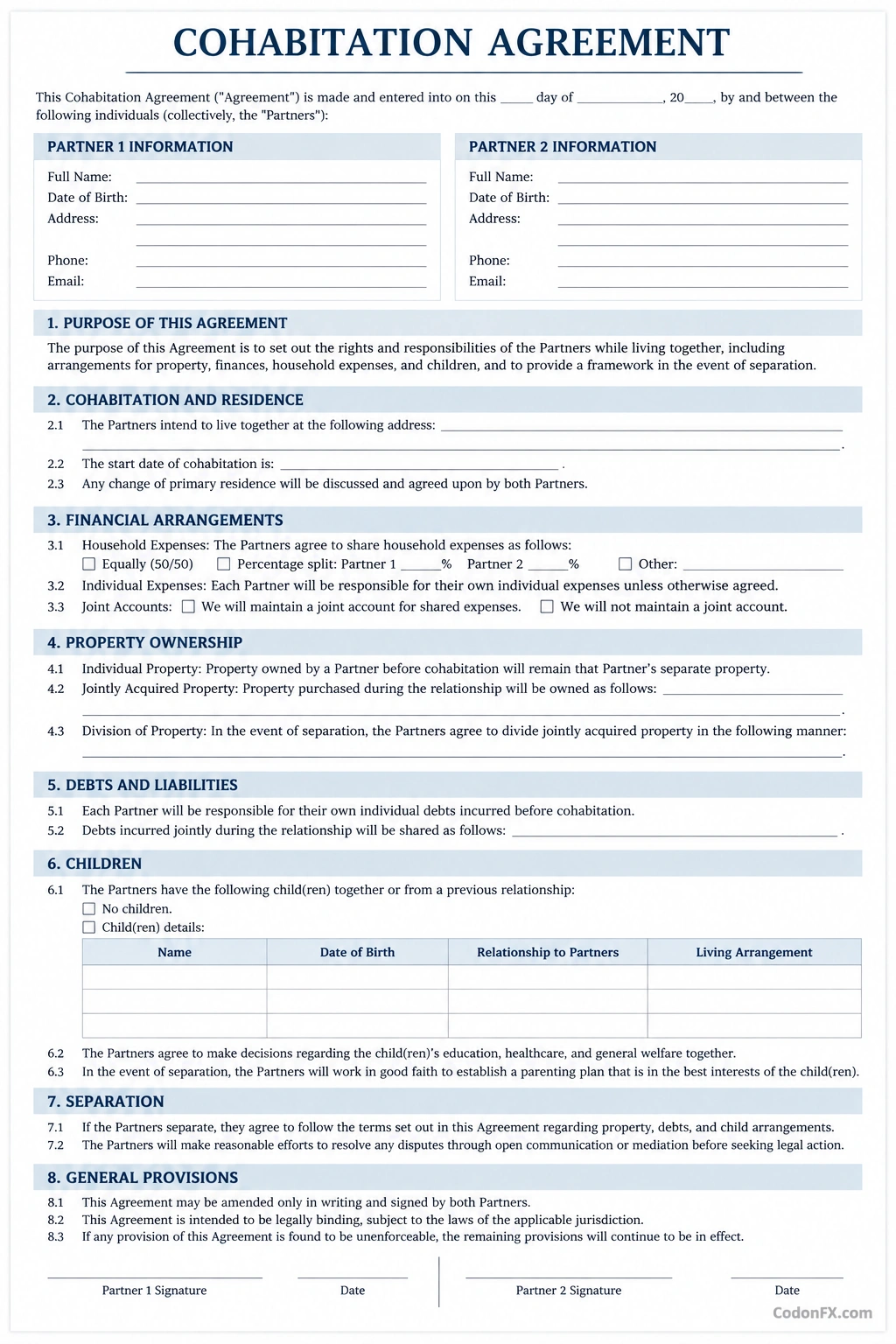
A cohabitation agreement template can provide a useful organizational starting point for couples who want to identify the subjects they should discuss.
A template can help organize topics such as:
- Partner information
- Residence information
- Financial arrangements
- Property ownership
- Debts and liabilities
- Children and family considerations
- Separation provisions
- Amendments
- Signatures
However, a template should not automatically be treated as a complete legal agreement for every couple or jurisdiction. The wording may need to be modified to reflect the partners’ circumstances and applicable law.
Common Mistakes to Avoid
Using a Generic Agreement Without Reviewing It
A generic form may not address important issues specific to a couple. Review every provision and determine whether it accurately reflects the partners’ intentions.
Failing to Disclose Important Assets or Debts
Incomplete financial information can create problems later. Partners should consider making a full and accurate disclosure of relevant financial circumstances when preparing the agreement.
Signing Under Pressure
Both partners should have sufficient time to review the document and understand its terms before signing. Independent legal advice can be particularly important when the agreement involves significant assets or financial differences.
Ignoring Local Legal Requirements
Rules concerning cohabitation agreements vary by jurisdiction. Requirements concerning enforceability, disclosure, signatures, witnesses, notarization, property, and family matters should be considered before relying on an agreement.
Never Updating the Agreement
Financial circumstances can change significantly over time. Marriage, separation, children, property purchases, inheritances, business interests, or major changes in income may justify reviewing the agreement.
When Should a Couple Create a Cohabitation Agreement?
Ideally, partners should discuss and finalize their agreement before moving in together or before acquiring significant joint assets. Creating the agreement before a major financial commitment can provide an opportunity for both people to consider their expectations without waiting for a dispute to arise.
However, couples who are already living together may still wish to document their financial and property arrangements. The appropriate approach depends on the circumstances and applicable law.
Frequently Asked Questions About Cohabitation Agreements
Is a cohabitation agreement legally binding?
A cohabitation agreement may be legally enforceable when it satisfies the requirements of the applicable jurisdiction. Enforceability can depend on factors such as proper execution, disclosure, fairness, voluntariness, and the specific provisions included in the agreement.
Can a cohabitation agreement protect property?
It can document the partners’ intended ownership and financial arrangements concerning property, but the legal effect depends on applicable law and the nature of the property. Real estate ownership, for example, may also depend on title and other legal documents.
Can a cohabitation agreement cover debts?
Yes, partners can generally use an agreement to document how they intend to handle individual and shared debts. However, an agreement between partners does not necessarily alter a creditor’s rights under a separate loan or credit contract.
Can a cohabitation agreement include children?
It can address the partners’ intentions regarding children, but family-law matters such as custody, parenting time, and child support may be governed by laws that limit the effect of private agreements. Professional legal advice is particularly important in this area.
Can a cohabitation agreement be changed?
Many agreements can be amended if both partners agree and the applicable legal requirements are followed. Significant changes in finances, property, family circumstances, or relationship status may be reasons to review an existing agreement.
Conclusion
A cohabitation agreement can provide unmarried couples with a structured way to document their financial and property arrangements while living together. By addressing issues such as household expenses, property ownership, debts, jointly acquired assets, and potential separation arrangements, partners can establish clearer expectations before disagreements arise.
A cohabitation agreement template can help organize these discussions and provide a starting framework, but the appropriate terms depend on the couple’s circumstances and the laws of the jurisdiction involved. Because these agreements can affect important legal and financial rights, both partners should consider obtaining independent legal advice before signing.
The goal of a well-prepared agreement is not simply to plan for separation. It is to give both partners a clear understanding of their financial responsibilities and property arrangements while they build their life together.
Download: Cohabitation Agreement Template
