A consignment agreement is a written contract that allows a business or individual to sell goods through another party without requiring the seller to purchase the inventory upfront. This arrangement can help product owners reach new customers while allowing retailers to offer products without the initial cost of buying stock.
Whether you operate a retail store, sell handmade products, distribute merchandise, or manage a small business, a clear consignment contract can help protect both parties. It establishes how goods will be handled, how sales will be reported, when payments are due, and what happens to unsold inventory.
Understanding the essential terms of a consignment agreement can help you avoid disputes and build a more reliable business relationship. This guide explains how consignment works, which clauses to include, and how to prepare an agreement that reflects the needs of both the consignor and the consignee.
What Is a Consignment Agreement?
A consignment agreement is a contract between a consignor, who owns or supplies the goods, and a consignee, who agrees to display, market, or sell those goods on the consignor’s behalf. The consignee typically receives an agreed commission or share of the sales proceeds.
Unlike a conventional wholesale transaction, the consignee generally does not purchase the inventory upfront. The consignor usually retains ownership of the goods until they are sold or another agreed event occurs, subject to the contract and applicable law.
Consignment arrangements are common in clothing boutiques, art galleries, antique stores, resale shops, furniture businesses, and other retail settings. They can also be used for handmade products, collectibles, and specialized merchandise.
How Does a Consignment Agreement Work?
A consignment arrangement allows a product owner to make goods available for sale through another business without transferring ownership immediately. The parties agree on the products, selling conditions, commission, reporting procedures, and other essential terms.
The process generally follows these steps:
- Delivery of goods: The consignor provides the agreed products to the consignee.
- Display and marketing: The consignee presents the products to potential customers through an agreed sales channel.
- Sale to customers: The consignee sells the products according to the agreed pricing and sales conditions.
- Sales reporting: The consignee records completed transactions and reports the results to the consignor.
- Payment: The consignor receives the agreed proceeds after applicable commissions or permitted deductions.
- Return of unsold goods: Products that remain unsold are handled according to the agreement.
The exact process depends on the business arrangement. A written contract should explain each stage so that both parties understand their responsibilities and financial obligations.
Who Are the Parties in a Consignment Agreement?
A consignment contract identifies the parties and defines their roles in the sales arrangement. Understanding these roles is essential before agreeing to the terms.
1. The Consignor
The consignor is the person or business that supplies the goods for sale. The consignor typically retains ownership of the inventory until the agreed transfer point and receives the sales proceeds after the applicable commission and authorized deductions.
The consignor may be a manufacturer, artist, designer, wholesaler, independent seller, or other product owner. Responsibilities often include providing accurate product information, delivering goods in suitable condition, and establishing the agreed pricing terms.
2. The Consignee
The consignee is the person or business that accepts the goods for sale. This party may display products in a store, list them online, promote them to customers, or use another approved sales channel.
The consignee usually earns a commission for completed sales. Depending on the contract, responsibilities may include protecting the inventory, maintaining sales records, communicating with customers, and paying the consignor within an agreed period.
What to Include in a Consignment Agreement
A well-written consignment agreement should clearly explain how the products will be managed and how the parties will share the results of their sales efforts. The following sections provide a practical starting point.
1. Contact Information and Party Details
Identify the consignor and consignee using their legal names or registered business names. Include appropriate addresses, contact information, and business details where relevant.
If a representative signs on behalf of a company, confirm that the person has the authority to enter into the agreement.
2. Description of the Consigned Goods
Provide a detailed list of the goods covered by the contract. Depending on the products, the inventory schedule may include descriptions, quantities, item codes, serial numbers, condition, and agreed retail prices.
For valuable or fragile items, consider recording their condition at delivery and attaching photographs. Both parties should confirm the inventory received to reduce disagreements about missing or damaged goods.
3. Consignment Period
Specify when the agreement begins and whether it ends on a particular date or continues until terminated according to its terms. The contract should explain whether the parties can extend the arrangement and how renewal will be confirmed.
Include procedures for ending the agreement, including the notice required, the deadline for settling outstanding sales, and the return of unsold products.
4. Pricing and Discount Authority
State the agreed selling price or explain how prices will be determined. If the consignee may offer discounts, specify the permitted limits and whether the consignor’s approval is required.
Clear pricing rules help protect profit margins and prevent disagreements about unauthorized promotions or below-cost sales.
5. Commission and Payment Terms
Explain how the consignee will be compensated for selling the goods. The agreement may use a percentage commission, a fixed fee, or another clearly defined arrangement.
Include the following details:
- The commission rate or fee structure.
- The amount used to calculate the commission.
- The treatment of discounts, refunds, and sales taxes.
- The payment schedule and payment method.
- The deadline for sending sales proceeds to the consignor.
- The process for resolving discrepancies in payment reports.
For example, the agreement might provide that the consignee receives a specified percentage of the eligible sale price for each completed transaction. The contract should explain whether that calculation is based on the price before or after discounts, refunds, taxes, or other permitted adjustments.
6. Inventory Ownership and Risk of Loss
Clarify when ownership of the goods transfers to the customer and whether the consignor retains ownership before a sale. The agreement should also address the risk of loss, theft, damage, and inventory shortages while the goods are in the consignee’s possession.
Do not assume that retaining ownership automatically determines every legal issue involving creditors, insolvency, or third-party claims. These matters can depend on local law and the specific circumstances of the arrangement.
7. Storage, Handling, and Insurance
Explain how the consignee must store, display, and handle the products. Fragile, perishable, high-value, or temperature-sensitive goods may require specific storage conditions.
Clarify who is responsible for insurance, if any, and what happens when inventory is damaged or lost. Both parties should understand the limits of any insurance coverage rather than assuming all losses are automatically covered.
8. Sales Records and Reporting
Accurate reporting allows the consignor to track inventory and verify payments. State how frequently the consignee must provide sales reports and which details the reports should contain.
Useful information may include opening inventory, units sold, remaining stock, discounts, refunds, commission calculations, and payments due. The agreement can also describe reasonable procedures for reviewing records and resolving discrepancies.
9. Returns, Refunds, and Unsold Goods
Explain how customer returns, cancellations, and refunds affect sales proceeds and commissions. The parties should also agree on how unsold inventory will be returned or handled when the contract ends.
Specify who pays for return shipping, how the products must be packed, and what happens if goods are returned in a damaged condition. A clear process can prevent disputes at the end of the consignment period.
10. Termination and Dispute Resolution
Include the circumstances under which either party may end the arrangement. These may include expiration of the agreed term, a material breach, failure to make required payments, or another specified event, subject to applicable law.
Describe the process for settling outstanding accounts, returning inventory, and resolving disagreements. The contract may specify a governing law or dispute resolution procedure where appropriate and legally effective.
Benefits of Using a Consignment Agreement
A consignment arrangement can offer practical advantages to both parties when the terms are clear and the products are suitable for the sales channel.
Benefits for the Consignor
- Broader market reach: Products can reach customers through another retailer’s store, website, or customer network.
- Lower upfront retail costs: The consignor may avoid establishing a dedicated storefront.
- Access to new sales channels: Consignment can help test demand in a new market.
- Greater product visibility: Products may benefit from the consignee’s existing customer relationships.
Benefits for the Consignee
- Reduced upfront inventory spending: Goods generally do not need to be purchased before they are offered for sale.
- Flexible product selection: The consignee can test products without committing to a conventional wholesale purchase.
- Commission-based earnings: The business can earn revenue from successful sales.
- Potentially broader inventory: Additional product categories may attract new customers.
However, consignment does not eliminate every risk. The consignor may still face unsold inventory and delayed revenue, while the consignee may incur storage, handling, marketing, and administrative costs.
How to Create a Consignment Agreement Step by Step
Preparing a consignment contract becomes easier when you organize the business terms before drafting the document.
Step 1: Identify the Products and Sales Channel
List the goods covered by the arrangement and identify where they may be sold. Clarify whether the consignee may sell through a physical store, an online marketplace, or other approved channels.
Step 2: Agree on Prices and Commission
Set the selling prices, commission structure, discount rules, and payment schedule. Use examples to confirm that both parties understand how sales proceeds will be calculated.
Step 3: Define Inventory Responsibilities
Agree on delivery records, storage requirements, inventory checks, damage reporting, and the return of unsold goods. Decide how shortages and disputed inventory counts will be investigated.
Step 4: Choose a Consignment Agreement Template
A consignment agreement template can provide a structured starting point for the contract. Choose one that includes party details, product descriptions, pricing, commission, payment terms, inventory responsibilities, and termination procedures.
Customize the template to reflect the actual business arrangement. A generic form may not address the requirements for particular goods, industries, or jurisdictions.
Step 5: Review, Sign, and Keep Records
Review the completed agreement and confirm that all important terms are clear. Attach inventory schedules and any relevant product condition reports.
Both parties should receive a signed copy and retain records of deliveries, sales, returns, payments, and written amendments. For complex arrangements, legal or accounting advice may help identify issues that a basic template does not cover.
Common Consignment Agreement Mistakes to Avoid
Several common mistakes can create unnecessary disagreements between consignors and consignees.
- Unclear commission terms: Define exactly how commissions and deductions are calculated.
- Incomplete inventory records: Record the quantities and condition of the goods delivered.
- Missing payment deadlines: Specify when sales reports and payments are due.
- Unclear damage responsibility: Explain how loss, theft, and damage will be handled.
- No return procedure: Establish how unsold goods and customer returns will be managed.
- Unrestricted discounting: Define who may change prices or authorize promotions.
- Using a generic agreement without review: Confirm that the terms suit the goods, business model, and applicable law.
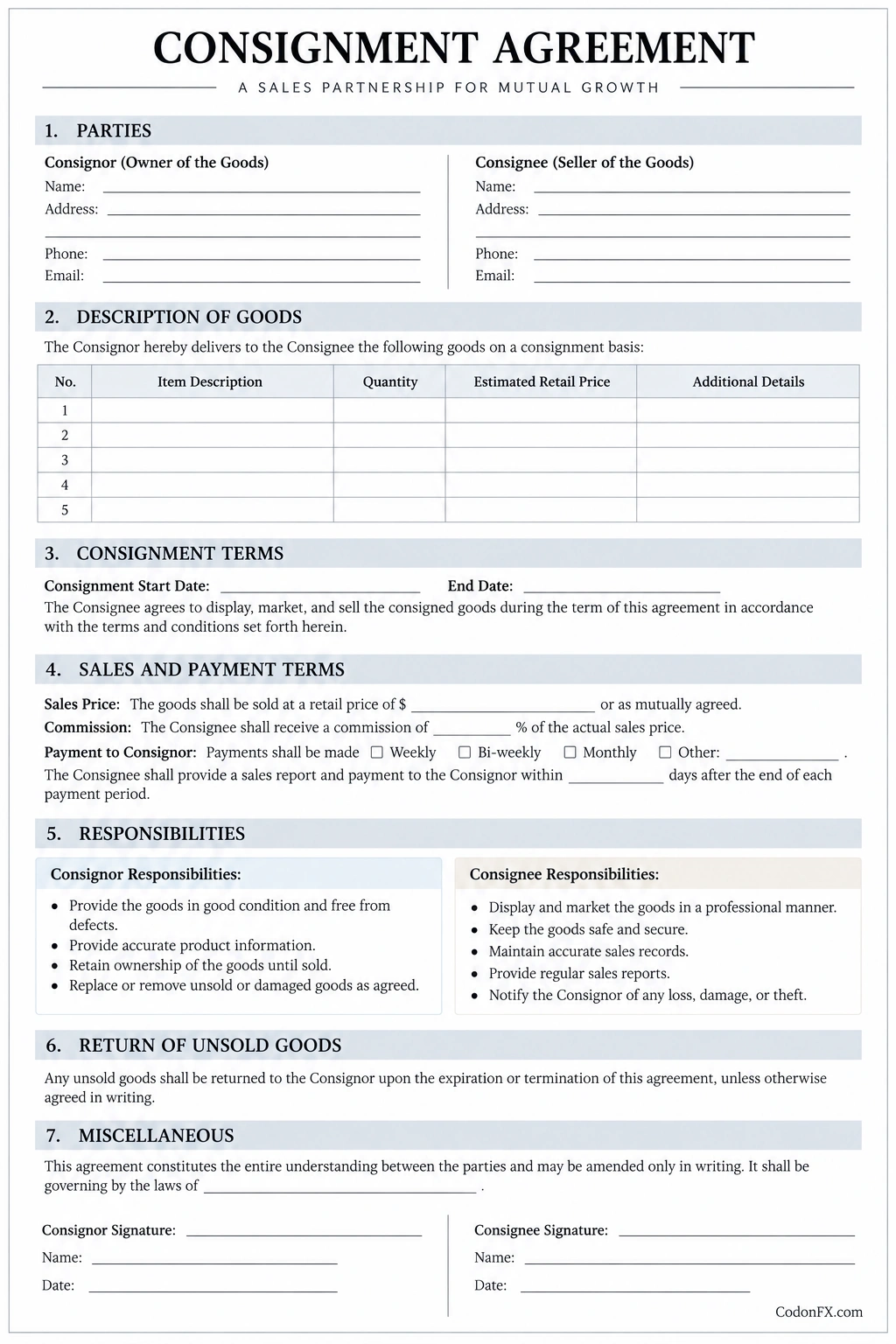
Consignment Agreement Template and Example
A printable consignment agreement template can help businesses document the key terms of a sales partnership. It is particularly useful for retailers, artists, designers, antique dealers, and small businesses that sell products on behalf of another party.
A typical agreement includes the names of the consignor and consignee, a description of the products, the consignment period, selling prices, commission, payment terms, inventory responsibilities, and conditions for returning unsold goods.
For example, an independent artist may place several pieces of artwork in a local gallery under a consignment arrangement. The contract could establish the agreed retail prices, the gallery’s commission, the schedule for reporting sales, the payment deadline, and the procedure for returning unsold artwork.
This example illustrates the structure of an arrangement rather than providing universal legal terms. The parties should agree on specific figures, responsibilities, and procedures that fit their circumstances.
Before using a consignment contract template, review each clause and add any terms required for the relevant products and location. A well-customized agreement can provide a useful record of the business relationship and help both parties manage expectations.
Frequently Asked Questions About Consignment Agreements
What is the purpose of a consignment agreement?
A consignment agreement establishes the terms under which a consignor supplies goods to a consignee for sale. It explains pricing, commissions, payment schedules, inventory responsibilities, ownership, and the treatment of unsold products.
Who owns the goods in a consignment arrangement?
The consignor generally retains ownership until the goods are sold or another agreed transfer point occurs. However, ownership, creditor rights, and insolvency issues can depend on the contract and applicable law.
How does a consignee make money?
A consignee commonly earns a commission or agreed fee for each completed sale. The contract should specify the calculation method and explain how discounts, refunds, taxes, and other adjustments affect the amount payable.
Is a written consignment agreement necessary?
A written agreement is strongly recommended because it documents the parties’ expectations and provides a reference for handling payments, inventory, returns, and disputes. Specific legal requirements vary by jurisdiction and transaction type.
What happens to unsold consignment goods?
Unsold goods are generally returned to the consignor or handled according to another agreed arrangement. The contract should specify the deadline, shipping responsibility, condition requirements, and process for resolving missing or damaged inventory.
Can I use a free consignment agreement template?
Yes. A free template can help organize the essential terms. However, it should be customized to the products, commission structure, sales channel, and applicable legal requirements before the parties sign it.
What is the difference between consignment and wholesale?
In a conventional wholesale transaction, a retailer generally purchases inventory from a supplier before reselling it. In a consignment arrangement, the consignee typically sells goods without purchasing them upfront and receives an agreed commission or fee.
Can a consignment agreement be terminated early?
Early termination depends on the agreement and applicable law. The contract should explain the permitted reasons for termination, any required notice, the settlement of outstanding payments, and the return of unsold goods.
Conclusion
A consignment agreement provides a framework for selling goods through another party without requiring the consignee to purchase inventory upfront. By clearly defining the products, pricing, commissions, payment terms, and inventory responsibilities, both parties can better manage the arrangement.
Start by identifying the goods and sales channel, then agree on compensation, reporting, storage, returns, and termination procedures. Use a suitable template as a starting point and customize it to reflect the actual business relationship.
Whether you are a product owner seeking new customers or a retailer expanding your product selection, a carefully prepared consignment agreement can support a more transparent and organized sales partnership.
Download: Consignment Agreement Template
