A commercial rental agreement is a written contract between a landlord and a business tenant that establishes the terms for renting commercial property. It explains how the property may be used, how much rent the tenant must pay, who is responsible for maintenance and repairs, and what obligations apply to both parties during the lease.
Commercial properties can include offices, retail stores, warehouses, restaurants, professional spaces, and other business locations. Because each property and business arrangement can be different, a commercial lease agreement often contains terms that are specifically negotiated between the landlord and tenant.
A clear agreement can help both parties understand their responsibilities before the tenant takes possession of the property. It can also provide a written reference for handling rent, maintenance, insurance, permitted use, renewal, termination, and other issues that may arise during the tenancy.
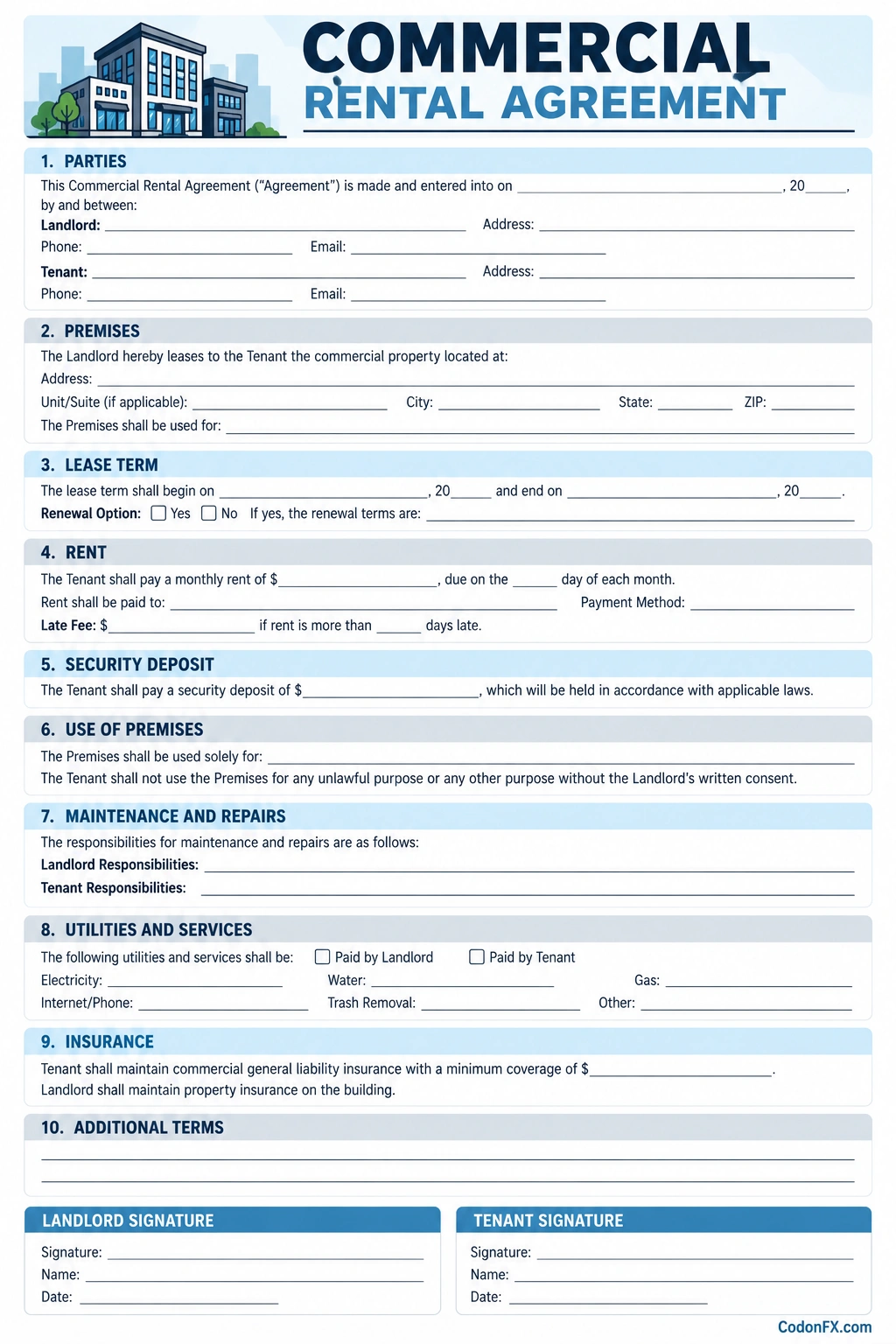
What Is a Commercial Rental Agreement?
A commercial rental agreement is a legal contract that sets out the terms under which a business tenant may occupy and use commercial property. The landlord grants the tenant the right to use the premises in exchange for rent and compliance with the agreed terms.
Unlike a simple residential rental arrangement, a commercial lease may need to address business-specific matters such as permitted business activities, operating requirements, signage, customer access, maintenance responsibilities, insurance, alterations, utilities, and compliance with applicable rules.
The agreement should clearly identify the property, the parties, the lease period, financial obligations, and other conditions that apply to the tenancy.
Why Is a Commercial Rental Agreement Important?
A written commercial lease provides a shared record of the terms agreed upon by the landlord and tenant. This can reduce uncertainty because important responsibilities are documented rather than left to informal conversations.
A commercial rental agreement can help:
- Identify the landlord and business tenant
- Define the commercial property being rented
- Establish the lease term
- Specify the rent and payment schedule
- Document the security deposit
- Define the permitted use of the property
- Clarify maintenance and repair responsibilities
- Address utilities and operating expenses
- Establish insurance requirements
- Explain renewal and termination provisions
- Document additional negotiated terms
A detailed agreement can also provide a useful reference if the parties later disagree about what was originally agreed.
What Should a Commercial Rental Agreement Include?
The exact contents of a commercial lease depend on the property, business, location, and negotiated terms. However, several sections are commonly important.
1. Landlord and Tenant Information
Begin by identifying the parties entering into the agreement. The landlord’s legal name and the tenant’s legal business name should be stated accurately.
Depending on the arrangement, the agreement may also include mailing addresses, contact information, and other identifying details.
2. Description of the Premises
Clearly identify the commercial property being rented. Include the property address and, where applicable, the building, unit, suite, floor, or other identifying information.
If the tenant has access to parking areas, storage areas, common areas, loading zones, or other portions of the property, the agreement should clearly address them when relevant.
3. Lease Term
The lease term establishes when the tenancy begins and when it ends. The agreement should specify the commencement date and expiration date.
If the parties have agreed to renewal options, those provisions should also be documented, including any applicable notice requirements or conditions.
4. Rent
The agreement should clearly state the rent amount, payment frequency, due date, payment method, and any applicable late-payment provisions.
Commercial leases may use different rent structures depending on the property and transaction. The agreement should accurately describe the arrangement negotiated by the parties.
5. Security Deposit
If a security deposit is required, the agreement should state the amount and explain how it will be handled, subject to applicable law.
The agreement may also address the circumstances under which deductions may be made and how the remaining deposit is handled when the tenancy ends.
6. Permitted Use
The permitted-use provision explains what the tenant may use the property for. This is particularly important for commercial property because different businesses may have different operational requirements.
For example, an agreement may specify that the premises are to be used for office operations, retail sales, professional services, warehousing, or another defined business purpose.
7. Maintenance and Repairs
The agreement should explain which party is responsible for maintaining and repairing different portions of the property.
Depending on the lease, responsibilities may include:
- Interior maintenance
- Exterior maintenance
- Structural repairs
- Plumbing
- Electrical systems
- Heating and cooling systems
- Common areas
- Landscaping
- Routine cleaning
Clear language can help both parties understand which responsibilities belong to the landlord and which belong to the tenant.
8. Utilities and Services
Commercial properties may have several utilities and services that need to be allocated between the parties.
These can include electricity, water, gas, internet, telephone services, trash removal, security services, and other property-related costs.
The agreement should explain which party pays each expense and, when relevant, how shared costs are calculated.
9. Insurance
Commercial leases often contain insurance requirements. The agreement may specify the types of insurance the tenant must maintain and any minimum coverage requirements.
The exact requirements should be appropriate for the property and business arrangement and should comply with applicable law and the parties’ contractual terms.
10. Alterations and Improvements
A business tenant may want to modify the premises to accommodate its operations. The lease should explain whether alterations require the landlord’s prior written consent.
It can also address issues such as permits, construction standards, restoration obligations, and ownership of improvements when the tenancy ends.
Types of Commercial Property That May Be Leased
A commercial rental agreement can be used for many types of business property, although the terms should be adapted to the specific property.
Office Space
Office leases may address work areas, conference rooms, shared facilities, parking, access hours, building services, and common areas.
Retail Space
Retail leases may need provisions concerning customer access, signage, storefronts, operating hours, deliveries, displays, and other retail-specific considerations.
Warehouse Space
Warehouse agreements may address storage, loading and unloading, vehicle access, security, equipment, inventory, and permitted activities.
Restaurant or Food Service Space
Restaurant leases can involve additional considerations such as kitchen equipment, ventilation, grease management, utilities, permits, waste disposal, and alterations.
How to Create a Commercial Rental Agreement
Creating a commercial rental agreement starts with identifying the basic business terms and then documenting the responsibilities of both parties.
Step 1: Identify the Parties
Confirm the correct legal names and contact information for the landlord and tenant.
Step 2: Describe the Property
Specify the exact premises being rented and identify any included areas or facilities.
Step 3: Define the Lease Term
Enter the beginning and ending dates of the tenancy and document any agreed renewal options.
Step 4: Establish Financial Terms
Document rent, security deposits, additional charges, payment dates, and other agreed financial obligations.
Step 5: Define Property Use
State the permitted business activities and identify any restrictions that apply to the tenant’s use of the premises.
Step 6: Assign Responsibilities
Clearly identify responsibilities for repairs, maintenance, utilities, insurance, taxes, cleaning, and other relevant costs.
Step 7: Add Additional Terms
Include other provisions negotiated by the parties, such as signage, subleasing, assignment, alterations, parking, access, renewal, default, and termination.
Step 8: Review Before Signing
Both parties should carefully review the agreement and make sure the written document reflects the terms they actually intend to accept.
Commercial Rental Agreement vs. Residential Lease
A commercial rental agreement and residential lease both establish a landlord-tenant relationship, but they serve different types of property and tenancy.
A residential lease generally concerns a person’s home, while a commercial lease concerns property used for business purposes.
Commercial agreements can be more heavily customized because businesses may have different operational requirements, property needs, financial arrangements, and negotiated responsibilities.
The applicable laws and regulations can also differ depending on the jurisdiction and type of property.
Important Commercial Lease Terms to Consider
In addition to the basic lease terms, parties may need to consider several additional provisions.
- Renewal: Explains whether and how the lease may be extended.
- Termination: Describes circumstances and procedures for ending the agreement.
- Default: Addresses what happens when a party fails to meet an important obligation.
- Subleasing: Explains whether the tenant may rent the premises to another business.
- Assignment: Addresses whether the tenant may transfer its lease rights.
- Signage: Establishes rules for signs, displays, and branding.
- Access: Defines when and how the landlord may access the premises.
- Compliance: Addresses applicable laws, regulations, permits, and property rules.
- Alterations: Establishes requirements for modifications to the premises.
Tips for Using a Commercial Rental Agreement Template
A commercial rental agreement template can provide a useful starting point, but it should not be treated as a universal contract that automatically fits every situation.
Before using a template, consider the following:
- Customize the property description.
- Use the correct legal names of the parties.
- Enter accurate rent and payment information.
- Clearly define the lease term.
- Review maintenance responsibilities.
- Specify utility and service obligations.
- Address insurance requirements.
- Include relevant renewal and termination provisions.
- Remove provisions that do not apply.
- Add terms that are important to the particular transaction.
Because commercial lease requirements can vary by jurisdiction and transaction, the parties may wish to have the agreement reviewed by a qualified legal professional before signing.
Common Mistakes to Avoid
Ambiguous or incomplete terms can create problems during a commercial tenancy. Take time to review the agreement carefully before execution.
- Using incorrect legal names
- Failing to clearly identify the premises
- Leaving the rent or payment schedule unclear
- Not defining maintenance responsibilities
- Ignoring utility and operating expenses
- Failing to document permitted use
- Overlooking renewal procedures
- Leaving termination terms ambiguous
- Failing to address alterations
- Using a generic template without adapting it to the transaction
Commercial Rental Agreement Checklist
Before signing a commercial rental agreement, the parties can review the following checklist:
- Landlord information completed
- Tenant information completed
- Property address verified
- Premises and included areas identified
- Lease start date confirmed
- Lease end date confirmed
- Rent amount confirmed
- Payment due date confirmed
- Security deposit documented
- Permitted use defined
- Maintenance responsibilities assigned
- Utility responsibilities assigned
- Insurance requirements reviewed
- Alteration provisions reviewed
- Renewal terms reviewed
- Termination provisions reviewed
- Additional terms documented
- Required signatures completed
Frequently Asked Questions About Commercial Rental Agreements
What is a commercial rental agreement?
A commercial rental agreement is a contract between a landlord and a business tenant that establishes the terms for renting commercial property. It can address rent, lease duration, permitted use, maintenance, utilities, insurance, and other responsibilities.
What should a commercial rental agreement include?
A commercial rental agreement commonly includes information about the parties, property, lease term, rent, security deposit, permitted use, maintenance, utilities, insurance, alterations, renewal, termination, and other negotiated terms.
Can I use a commercial rental agreement template?
Yes. A commercial rental agreement template can provide a useful starting structure, but it should be customized to the property, transaction, parties, and applicable requirements. A qualified legal professional can review the final agreement when appropriate.
What is the difference between a commercial lease and a residential lease?
A commercial lease is designed for business property, while a residential lease is designed for housing. Commercial leases often contain provisions tailored to business operations and may be more extensively negotiated.
Who is responsible for repairs in a commercial rental agreement?
The responsible party depends on the terms of the agreement. A commercial lease should clearly state which maintenance and repair obligations belong to the landlord and which belong to the tenant.
Can a commercial rental agreement be customized?
Yes. Commercial rental agreements are commonly customized to address the property, business use, rent structure, maintenance obligations, insurance, renewal rights, alterations, and other terms negotiated by the parties.
Conclusion
A commercial rental agreement provides a written framework for the relationship between a landlord and a business tenant. It establishes the tenant’s right to use the commercial property while documenting important financial, operational, maintenance, and contractual responsibilities.
A well-organized commercial rental agreement template can make it easier to identify the essential terms that need to be discussed and documented. However, every commercial property and transaction can be different, so the agreement should be carefully customized rather than used without review.
Before signing, both parties should make sure the document accurately reflects their agreement and addresses the important responsibilities associated with the property. Because commercial lease laws and requirements vary by jurisdiction, professional legal review may be appropriate for a specific transaction.
Download: Commercial Rental Agreement Template
