A contractor quote provides a clear, formal price for a construction, renovation, repair, or home improvement project. It helps clients understand the expected cost, scope of work, materials, and project timeline before hiring a contractor. A well-prepared contractor quote also reduces misunderstandings by explaining exactly what the proposed price includes.
Whether you are a general contractor, remodeling specialist, electrician, plumber, or independent tradesperson, creating professional quotes is an important part of winning jobs and managing client expectations. A detailed quote makes your pricing easier to understand and gives both parties a written reference for the agreed work.
In this guide, you will learn what a contractor quote should include, how to calculate project costs, how it differs from an estimate, and how to use a printable contractor quote template to prepare a professional document.
What Is a Contractor Quote?
A contractor quote is a written proposal that specifies the price and terms for completing a defined project. It commonly includes a description of the work, labor charges, material costs, additional fees, payment terms, and the expected project schedule.
Contractors use quotes to explain their proposed pricing before work begins. For example, a remodeling contractor might prepare a quote for renovating a kitchen, while a plumber might provide one for installing new fixtures or replacing pipes.
Unlike a preliminary estimate, a contractor quote generally aims to provide a specific price for an agreed scope of work. However, whether the price is legally binding depends on the wording, acceptance, applicable law, and any conditions stated in the document. A quote should clearly explain how changes to the original project will be handled.
Why Is a Contractor Quote Important?
A professional contractor quote benefits both the contractor and the client by establishing clear expectations before a project starts. It also provides a useful reference for project planning, cost control, and communication.
- Establishes pricing clarity: Clients can review the proposed price and understand the costs associated with the work.
- Defines the project scope: A detailed description identifies which tasks, materials, and services are included.
- Reduces misunderstandings: Written terms help prevent disagreements about pricing, exclusions, and responsibilities.
- Supports project planning: Contractors can organize labor, materials, equipment, and scheduling requirements.
- Improves professionalism: A consistent, well-formatted quote presents the business in a credible and organized manner.
- Creates a financial reference: Both parties can compare the proposed price with approved changes and final billing.
A contractor quote cannot prevent every dispute, but a clear document makes it easier to understand the original agreement and identify any changes that occur during the project.
What Should a Contractor Quote Include?
A complete contractor quote should contain enough detail for the client to understand the proposed work, price, and conditions. The exact requirements depend on the project type and local regulations.
1. Contractor and Client Information
Begin with the contractor’s business name, address, phone number, and email address. Include any required business registration or contractor license information, where applicable.
Add the client’s name, contact details, and project address. Accurate information helps both parties identify the document and communicate about the proposed work.
2. Quote Number and Validity Period
Assign a unique quote number to each proposal. Include the date the quote was issued and the date it expires, if applicable.
A validity period is especially useful when material prices, supplier availability, or labor costs may change. State clearly whether the proposed price remains available until a specific date and what happens if the client accepts it afterward.
3. Detailed Scope of Work
Describe the work the contractor agrees to perform. Include relevant tasks, project specifications, materials, installation requirements, and expected deliverables.
For example, a bathroom renovation quote might identify the removal of existing fixtures, installation of new fittings, plumbing modifications, tile work, and cleanup. Avoid vague descriptions that leave the client uncertain about what is included.
List exclusions separately. These may include permits, specialist services, concealed structural repairs, or additional work that cannot be confirmed before the project begins. Explain how unforeseen conditions will be assessed and priced.
4. Itemized Labor and Material Costs
A cost breakdown helps clients understand how the total price is calculated. Depending on the project, include separate line items for labor, materials, equipment rental, subcontractors, delivery, disposal, and other applicable expenses.
Where useful, show the quantity, unit, unit price, and line total for each item. Itemization also makes it easier to revise a quote if the client changes the selected materials or requests additional work.
5. Subtotal, Taxes, and Total Price
Calculate the subtotal by adding the quoted line items. Then include applicable taxes and other disclosed fees to arrive at the final quoted price.
Make sure the total is consistent with the itemized breakdown. State whether taxes are included or listed separately, and follow the tax and pricing disclosure rules that apply to your business and location.
6. Project Timeline and Milestones
Include the expected start date, estimated duration, and anticipated completion date when these details can reasonably be established. For larger projects, identify major milestones such as demolition, installation, inspection, and final handover.
Explain that scheduling may depend on factors such as permits, material availability, weather, site access, and client approvals. Clearly stated assumptions help avoid unrealistic expectations.
7. Payment Terms and Conditions
Specify when payments are due and whether the arrangement includes a deposit, milestone payments, progress payments, or a final balance. Explain accepted payment methods and any applicable late-payment terms.
Also describe how changes to the scope of work will be approved and priced. Written change orders are useful for documenting additional tasks, revised costs, and potential schedule changes before the extra work proceeds.
8. Acceptance and Signatures
Include an acceptance section that identifies how the client can approve the quote. Depending on the business process, this may involve a signature, written confirmation, or electronic acceptance.
State what acceptance means and identify any additional contract documents or disclosures that are required. For construction and home improvement work, local law may impose specific requirements regarding contracts, cancellation rights, deposits, licensing, or notices.
How to Calculate a Contractor Quote
Preparing an accurate contractor quote requires more than adding labor and material expenses. You also need to account for operating costs, the desired profit, applicable taxes, and the risks associated with the project.
Step 1: Assess the Project
Review the project specifications, inspect the site when necessary, and clarify the client’s expectations. Identify the labor, materials, equipment, and subcontractors required to complete the work.
Step 2: Calculate Direct Costs
Add the expected costs of labor, materials, equipment, delivery, and subcontracted services. Use current supplier prices and realistic labor hours wherever possible.
For example, if a project requires $1,200 in materials and $1,800 in labor, the direct cost subtotal is $3,000 before other expenses.
Step 3: Include Overhead
Account for appropriate business expenses such as insurance, transportation, administration, tools, and other operating costs that are not already included in the direct costs.
Allocating overhead helps ensure that the quoted price supports the actual cost of running the business.
Step 4: Add Profit
Choose a pricing method that supports your target profit while remaining appropriate for the market and project requirements. Understand the difference between markup and profit margin when calculating your final price.
For example, applying a 20% markup to a total cost of $3,500 produces a price of $4,200 before applicable taxes. That price represents a 16.7% margin on the selling price, not a 20% profit margin.
Step 5: Review the Quote
Check the scope, quantities, calculations, exclusions, payment schedule, and project timeline. Confirm that every important assumption is documented and that the total price matches the itemized costs.
Contractor Quote Example
Consider a contractor preparing a quote for a small home improvement project. The following example shows how the proposed price might be organized.
- Materials: $1,200
- Labor: $1,800
- Equipment and delivery: $200
- Total direct costs: $3,200
- Overhead allocation: $300
- Total estimated business cost: $3,500
- Profit allowance: $700
- Quoted subtotal: $4,200
In this example, the proposed quote is $4,200 before applicable taxes or additional fees. These figures are illustrative and should be adjusted to reflect actual labor rates, supplier prices, project risks, and business expenses.
The final quote should also explain the work included in the price, any exclusions, the payment schedule, and the conditions for approving changes.
Free Printable Contractor Quote Template
A printable contractor quote template provides a consistent format for preparing project proposals without creating a new document from scratch. It is useful for general contractors, renovation companies, repair professionals, and independent tradespeople.
The template below includes contractor and client details, quote information, project specifications, an itemized cost breakdown, notes, taxes and fees, payment terms, and client acceptance fields.
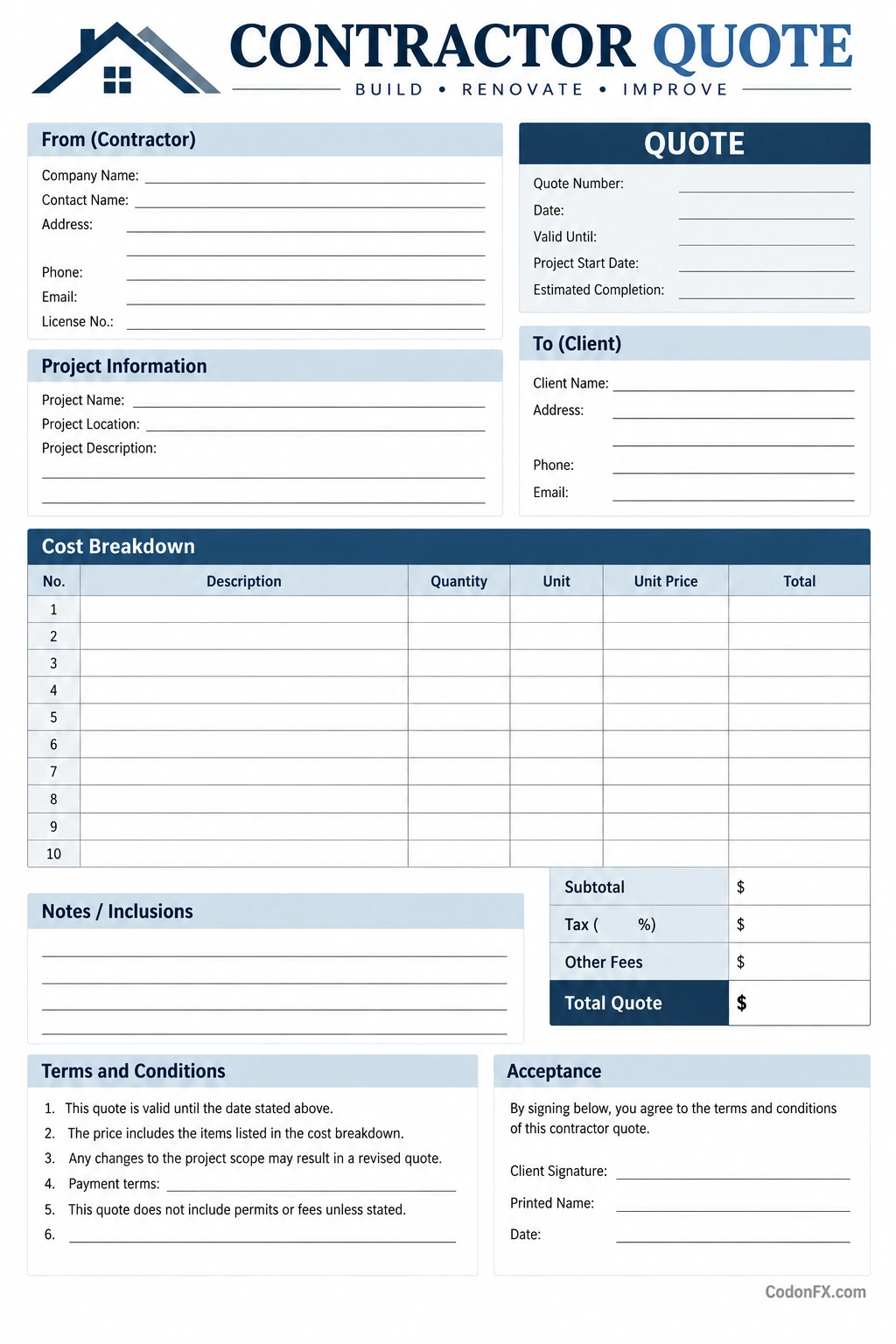
To use the template, enter your business and client information, describe the project, and list each cost separately. Add the subtotal, applicable taxes, other fees, and total quoted price.
Complete the notes and terms sections with relevant inclusions, exclusions, payment conditions, and scheduling assumptions. Review the document before sending it to the client, and keep a copy of every quote you issue.
When a client requests a change, prepare a revised quote or written change order that identifies the updated scope, price, and timeline. This helps both parties maintain a clear record of the latest proposal.
Contractor Quote vs. Estimate vs. Invoice
These documents may contain similar information, but each serves a different purpose. Choosing the correct document helps establish clear expectations at every stage of a project.
- Contractor quote: Presents a proposed price for a defined scope of work. It is often intended to be a fixed-price offer, subject to its stated conditions and applicable law.
- Contractor estimate: Provides an approximate cost based on available information. The final amount may change as more details become available.
- Contractor invoice: Requests payment for work performed, materials supplied, or amounts due under the applicable agreement.
An accepted quote may form a legally binding agreement when the applicable requirements for contract formation are met. However, acceptance does not automatically settle every legal issue. The wording, conditions, scope, required disclosures, and relevant law all matter.
For significant construction or renovation projects, a separate written contract may be needed to address warranties, insurance, liability, cancellation rights, dispute resolution, and other legal obligations.
Tips for Creating a Professional Contractor Quote
A clear and consistent quoting process can improve client communication and help protect your business from avoidable disputes.
- Be specific about the scope: Describe the work and identify what is excluded.
- Use itemized pricing: Show meaningful cost categories instead of relying on an unexplained total.
- Verify material prices: Check supplier quotations and availability before finalizing the price.
- Set a validity period: Explain how long the proposed price remains available.
- Document assumptions: Identify site conditions, client selections, or approvals that may affect the project.
- Explain payment terms: Clearly state deposits, milestones, due dates, and final payment requirements.
- Use written change orders: Document approved changes to scope, price, and schedule.
- Check local requirements: Confirm applicable licensing, tax, contract, and consumer protection rules.
- Keep organized records: Store quotes with reference numbers, issue dates, client details, and revision history.
Before sending the quote, review it from the client’s perspective. The client should be able to understand exactly what the contractor proposes to do, how much it will cost, when the work is expected to occur, and what conditions apply.
Frequently Asked Questions About Contractor Quotes
What is a contractor quote?
A contractor quote is a written proposal that outlines the price, scope of work, and relevant terms for a construction, repair, or renovation project. It helps the client evaluate the proposal before deciding whether to accept it.
Is an accepted contractor quote legally binding?
An accepted quote can become a legally binding agreement when the requirements for contract formation are met under applicable law. The result depends on the quote’s wording, acceptance process, conditions, and circumstances. Some projects also require a separate contract or additional disclosures.
What is the difference between a contractor quote and an estimate?
A contractor quote generally offers a specific price for a defined scope of work, while an estimate provides an approximate cost. The legal and financial effect of either document depends on its terms and applicable law.
How long should a contractor quote be valid?
The validity period depends on the project, supplier pricing, and contractor’s policies. A quote might remain valid for a specified number of days, but the contractor should state the exact expiration date and explain any conditions that apply.
Should a contractor quote include labor and materials?
Yes, a useful quote should explain the costs covered by the proposed price. Labor and materials are commonly listed separately, along with equipment, subcontractors, delivery, taxes, and other applicable expenses.
Can a contractor change the price after a quote is accepted?
Changes depend on the agreement and applicable law. Additional work, approved variations, or contractually permitted adjustments may change the price. Contractors should document the reason, revised cost, and schedule implications and obtain the required approval before proceeding.
Does a contractor quote need a signature?
A signature is one way to document acceptance, but other acceptance methods may be valid depending on the agreement and applicable law. Certain projects require specific written contracts, signatures, notices, or disclosures. Check the requirements that apply to the project location and type.
Can I use a free contractor quote template?
Yes. A free template can help organize project information and pricing. Customize it for each job and confirm that it contains the necessary scope, exclusions, payment terms, and legal disclosures. A generic template may not satisfy every requirement for a construction or home improvement contract.
Conclusion
A professional contractor quote helps define the proposed scope, price, and timeline before a construction, repair, or renovation project begins. By clearly documenting labor, materials, additional expenses, payment terms, and exclusions, contractors can communicate pricing more effectively and reduce misunderstandings.
A printable contractor quote template makes it easier to prepare consistent proposals and maintain organized records. Customize the document for each project, verify your calculations, and confirm the applicable legal requirements before requesting acceptance.
With a clear quoting process and well-documented terms, you can present professional proposals, manage client expectations, and establish a stronger foundation for successful projects.
Download: Contractor Quote Template
