A collective bargaining agreement is a legally binding agreement between an employer and a labor union that establishes the terms and conditions of employment for a defined group of workers. It provides a structured framework for addressing wages, benefits, working conditions, workplace rules, employee rights, and procedures for resolving disputes.
Instead of negotiating employment terms individually, employees represented by a union negotiate collectively with the employer. The resulting agreement documents the terms that both parties have accepted and provides clear guidelines for the employment relationship during the agreement’s effective period.
A well-written collective bargaining agreement can help establish consistency and predictability in the workplace. By clearly defining responsibilities, compensation, benefits, working conditions, and dispute resolution procedures, the agreement can reduce uncertainty and provide a framework for handling workplace issues.
What Is a Collective Bargaining Agreement?
A collective bargaining agreement, often abbreviated as CBA, is a formal agreement negotiated between an employer and a labor union representing a group of employees. It establishes rules and conditions that apply to employees covered by the bargaining unit.
The agreement typically results from collective bargaining, a negotiation process in which representatives of the union and employer discuss employment conditions and attempt to reach mutually acceptable terms.
Once an agreement is finalized and becomes effective, the parties are expected to follow its applicable provisions. The specific legal effect, enforcement mechanisms, and requirements vary according to applicable labor laws and the terms of the agreement.
Why Is a Collective Bargaining Agreement Important?
A CBA provides a written reference for both employees and management. Instead of relying entirely on informal workplace practices or individual discussions, the parties can refer to the agreement when questions arise about employment conditions.
A collective bargaining agreement may help:
- Define wages and compensation structures.
- Establish employee benefits.
- Set working hours and overtime rules.
- Define workplace conditions and employment standards.
- Establish procedures for handling grievances.
- Clarify the rights and responsibilities of the employer and union.
- Provide procedures for addressing workplace disputes.
- Create greater consistency in how covered employees are treated.
- Establish the duration and renewal process for the agreement.
The agreement does not eliminate every workplace disagreement. Instead, it provides a framework for addressing issues according to previously established procedures.
What Does a Collective Bargaining Agreement Cover?
The contents of a collective bargaining agreement vary by industry, employer, union, and jurisdiction. However, many agreements address several common areas of employment.
Wages and Compensation
Compensation is often one of the central subjects of collective bargaining. The agreement may establish wage rates, pay classifications, salary increases, differentials, bonuses, or other forms of compensation.
Some agreements include wage tables or appendices that specify compensation according to job classification, experience, seniority, or other factors.
Employee Benefits
A CBA may establish or address benefits available to covered employees. Depending on the agreement, these provisions can include health insurance, retirement benefits, paid time off, holidays, leave policies, and other employment benefits.
The agreement should clearly identify which benefits are covered and explain any applicable eligibility requirements or limitations.
Working Hours and Overtime
Working hours can be another important component of a collective bargaining agreement. The agreement may establish regular schedules, shifts, overtime eligibility, overtime rates, rest periods, or scheduling procedures.
Clear scheduling provisions can help employees and management understand how working time is organized and how additional hours are handled.
Working Conditions
Working conditions provisions may address workplace safety, equipment, job assignments, work rules, staffing practices, or other conditions relevant to the employees covered by the agreement.
These provisions can provide a common set of expectations for both management and employees.
Grievance and Dispute Procedures
Many collective bargaining agreements establish a grievance procedure for resolving disagreements concerning the interpretation or application of the agreement.
The procedure may specify how a grievance is submitted, who reviews it, applicable deadlines, escalation steps, and whether unresolved matters can proceed to arbitration or another form of dispute resolution.
Key Elements of a Collective Bargaining Agreement
Although every CBA is different, a well-organized agreement commonly contains several foundational sections.
Parties to the Agreement
The agreement should identify the employer and the labor union that are entering into the contract. It may also identify authorized representatives for each party.
Recognition and Bargaining Unit
A recognition section may identify the union as the bargaining representative for a defined group of employees. The agreement should make the scope of the bargaining unit clear.
Effective Date and Term
The agreement should state when it becomes effective and how long it remains in effect. Some agreements also describe procedures for renewal, reopening negotiations, or modifying the agreement.
Compensation Provisions
Compensation provisions explain the applicable wage structure and other financial terms. Supporting schedules or appendices may provide detailed wage classifications and rates.
Benefits
The benefits section identifies applicable employee benefits and any relevant conditions or procedures.
Workplace Rules
Workplace rules can cover scheduling, overtime, leave, seniority, job assignments, safety, and other employment conditions.
Grievance Procedure
The grievance section establishes a process for raising and resolving disputes under the agreement. Clear procedures can help ensure that workplace concerns are handled consistently.
Signatures
The agreement should include appropriate signature blocks for authorized representatives of the employer and union. The signatures demonstrate the parties’ execution of the agreement according to the applicable process.
How Collective Bargaining Works
Collective bargaining is a negotiation process rather than simply the preparation of a document. Representatives for the employer and union discuss proposed employment terms and negotiate the provisions that will eventually appear in the agreement.
1. Identify Negotiation Priorities
The parties typically identify the subjects they want to address or change. These may include compensation, benefits, scheduling, workplace rules, or other employment conditions.
2. Exchange Proposals
Representatives may present proposals and counterproposals concerning the terms of employment. Negotiations can involve multiple rounds of discussion.
3. Negotiate the Terms
The parties work through areas of disagreement and attempt to reach mutually acceptable terms. Some provisions may be revised several times before the parties reach an agreement.
4. Finalize the Agreement
Once the negotiated terms are settled, the final agreement is prepared for approval and execution according to the applicable procedures.
5. Implement the Agreement
After the agreement becomes effective, the employer and union follow the applicable provisions. Employees and managers may use the CBA as a reference when questions arise concerning covered employment conditions.
Collective Bargaining Agreement and Employee Rights
A collective bargaining agreement can establish contractual protections and procedures for employees covered by the bargaining unit. These may include wage provisions, scheduling rules, grievance procedures, seniority provisions, and other negotiated terms.
However, a CBA generally operates alongside applicable employment laws and regulations. A provision in an agreement does not necessarily replace statutory requirements or other legal obligations.
Employees should review the agreement applicable to their bargaining unit and understand how its provisions interact with workplace policies and applicable law.
Collective Bargaining Agreement and Employer Responsibilities
Employers that are parties to a CBA have responsibilities under the agreement’s applicable provisions. These may include following negotiated wage schedules, honoring agreed procedures, administering benefits according to the agreement, and participating in grievance or dispute procedures when required.
Managers and supervisors should understand the provisions that apply to their employees. Consistent administration can help reduce confusion and prevent avoidable disputes.
Common Sections in a CBA
A collective bargaining agreement may contain many sections depending on the needs of the workplace. Common sections include:
- Purpose and scope.
- Union recognition.
- Definitions.
- Management rights.
- Union rights and responsibilities.
- Wages and salary schedules.
- Hours of work.
- Overtime.
- Holidays and paid time off.
- Health and welfare benefits.
- Retirement benefits.
- Seniority.
- Job classifications.
- Transfers and promotions.
- Layoffs and recalls.
- Workplace safety.
- Discipline and discharge procedures.
- Grievance and arbitration procedures.
- Term and renewal.
- Signature and execution provisions.
How to Create a Collective Bargaining Agreement
Creating a CBA requires careful attention to the negotiated terms and the legal requirements that apply to the parties. A template can provide a useful organizational starting point, but the final agreement should reflect the actual terms negotiated by the employer and union.
Define the Parties
Clearly identify the employer and union and provide the appropriate contact or representative information.
Define the Scope
Explain which employees are covered by the agreement and identify the relevant bargaining unit.
Document Negotiated Terms
Record the agreed provisions concerning compensation, benefits, schedules, working conditions, seniority, leave, and other negotiated subjects.
Establish Dispute Procedures
Include a clear grievance procedure that explains how covered disputes should be raised and addressed.
Specify the Agreement Term
State the effective date and expiration date, along with any applicable renewal or renegotiation provisions.
Review and Execute the Agreement
Before execution, the parties should carefully review the final language to ensure that it accurately reflects the negotiated terms. Authorized representatives can then execute the agreement according to the applicable requirements.
Common Mistakes to Avoid
A collective bargaining agreement should be specific enough to provide meaningful guidance without creating unnecessary ambiguity. Common problems include:
- Using unclear language: Ambiguous provisions can create disagreements about interpretation.
- Failing to define the bargaining unit: The agreement should clearly identify which employees are covered.
- Leaving compensation terms incomplete: Wage rates and applicable pay provisions should be clearly documented.
- Ignoring dispute procedures: The agreement should explain how grievances are handled.
- Forgetting the effective period: Include clear effective and expiration dates.
- Inconsistent terminology: Use defined terms consistently throughout the agreement.
- Failing to review supporting schedules: Appendices and wage tables should match the main agreement.
- Using a generic template without customization: A template should be adapted to the actual bargaining relationship and applicable requirements.
Benefits of Using a Collective Bargaining Agreement Template
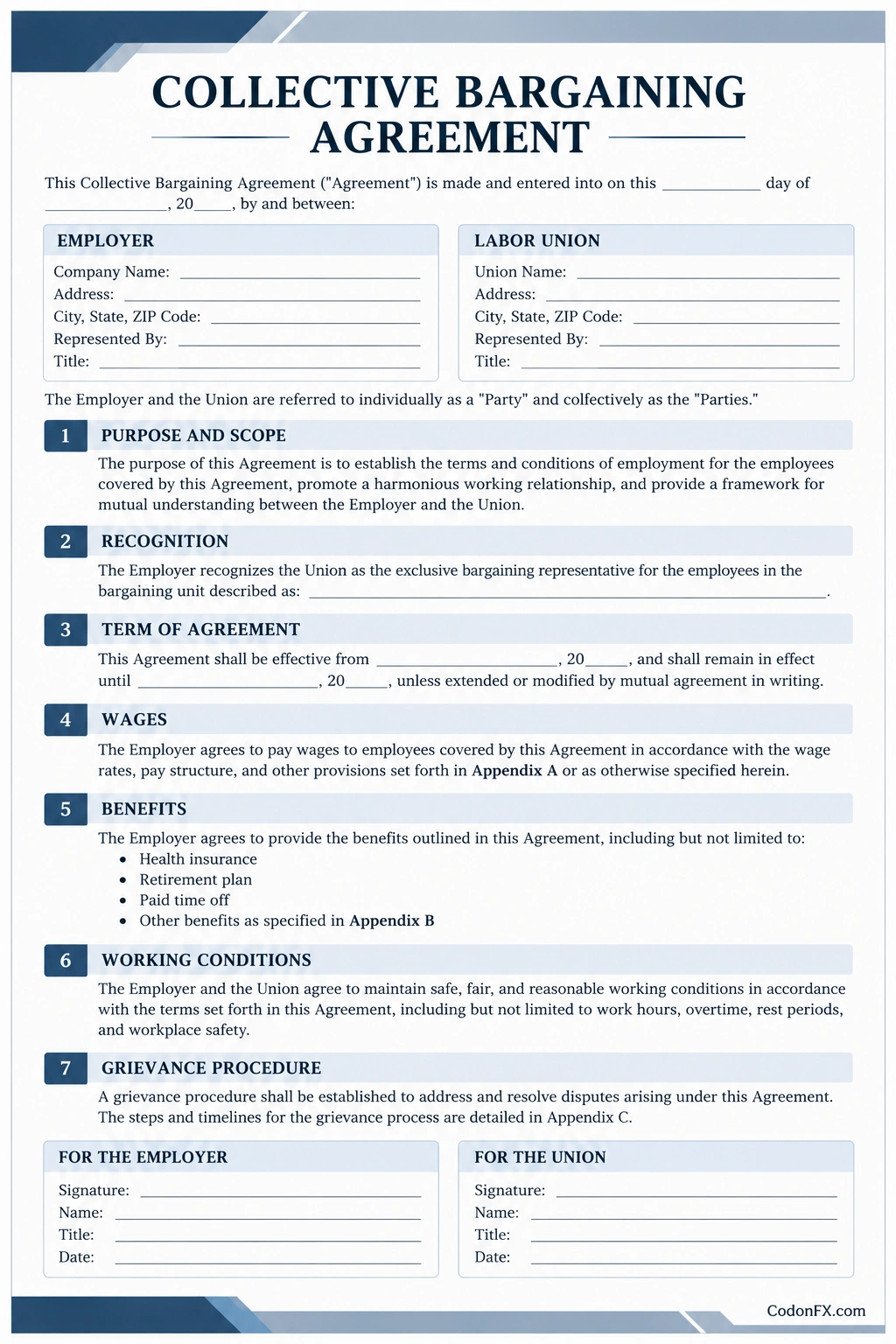
A collective bargaining agreement template can help organize the major sections of an agreement before the parties finalize their negotiated terms. A structured template can provide placeholders for employer information, union information, wages, benefits, working conditions, grievance procedures, and signatures.
Using a template can also make it easier to review whether important subjects have been addressed. However, the template should not be treated as a substitute for professional legal review.
Employment and labor laws can vary by jurisdiction and industry, and the terms of a CBA can have significant legal consequences. The final document should be reviewed by appropriate labor relations or legal professionals when necessary.
Collective Bargaining Agreement vs. Employment Contract
A collective bargaining agreement and an individual employment contract are not necessarily the same type of document.
An employment contract generally establishes terms between an individual employee and an employer. A CBA establishes negotiated terms for a group of employees represented by a union.
The CBA may govern employment conditions for covered employees, while individual documents or workplace policies may address matters not specifically covered by the agreement, subject to applicable law and the terms of the CBA.
Tips for Maintaining a CBA
Creating the agreement is only the beginning. The parties should also maintain accurate records of the current agreement and any amendments or side agreements that affect its provisions.
- Keep an accessible copy of the current agreement.
- Clearly document amendments and negotiated changes.
- Track the agreement’s expiration date.
- Review wage schedules and appendices for consistency.
- Make grievance procedures available to appropriate employees and representatives.
- Communicate significant changes clearly.
- Maintain accurate records of executed agreements.
Final Thoughts on Collective Bargaining Agreements
A collective bargaining agreement provides a formal framework for the employment relationship between an employer and a labor union representing covered employees. By documenting wages, benefits, working conditions, workplace rules, and dispute resolution procedures, the agreement can provide greater clarity about the rights and responsibilities of the parties.
A well-organized CBA should accurately reflect the terms negotiated by the employer and union and clearly define how those terms will operate during the agreement’s effective period. It should also be reviewed carefully to ensure consistency with applicable labor laws and other legal requirements.
Whether you are organizing an existing agreement or preparing a starting framework for negotiations, a structured Collective Bargaining Agreement Template can help keep important provisions organized and easy to review.
Download: Collective Bargaining Agreement Template
