Competitive analysis is an essential business process for understanding your position in the market and identifying opportunities to outperform competing businesses. By evaluating competitors’ products, pricing, marketing strategies, strengths, and weaknesses, you can make better decisions about your own business strategy.
Whether you are launching a startup, managing an established company, or developing a new product, competitive analysis helps you understand what other businesses do well and where they fall short. These insights can reveal market gaps, improve customer positioning, and help you build a sustainable competitive advantage.
A competitive analysis template makes the process easier by organizing competitor information into a structured worksheet. Instead of relying on assumptions, you can compare relevant businesses, identify patterns, and turn research into practical action steps.
What Is Competitive Analysis?
Competitive analysis is the process of researching and evaluating businesses that compete for the same customers, market share, or industry opportunities. It examines how competitors position their products, attract customers, set prices, and communicate their value.
The goal is not simply to copy successful competitors. Instead, competitive analysis helps you understand the market, recognize customer needs, and determine how your business can offer something valuable and distinctive.
A comprehensive competitor analysis may examine the following areas:
- Products and services: What competitors sell and how their offerings compare with yours.
- Pricing strategy: How competitors price their products, services, subscriptions, or packages.
- Target audience: Which customer groups they serve and how they position their offerings.
- Marketing strategy: How they attract customers through content, advertising, social media, and other channels.
- Customer experience: How they handle service, support, delivery, and customer feedback.
- Strengths and weaknesses: What competitors do effectively and where they may have limitations.
- Market opportunities: Customer needs, underserved segments, or product gaps that your business could address.
Why Is Competitive Analysis Important?
Understanding competitors helps businesses make informed decisions rather than relying entirely on assumptions. It can also reveal changes in customer expectations and industry trends before they become major challenges.
1. Identify Your Competitive Advantage
Competitive analysis helps you determine what makes your business different. Your advantage might come from product quality, specialized expertise, customer service, convenience, pricing, or a more focused target audience.
Once you understand how competitors position themselves, you can communicate your own value more clearly and avoid competing only on price.
2. Discover Market Gaps
Competitors may overlook certain customer groups, product features, service expectations, or pricing needs. These gaps can create opportunities for businesses that understand their customers well.
For example, a software company might discover that existing products offer advanced features but are difficult for beginners to use. A simpler product with better onboarding could address that unmet need.
3. Improve Marketing Decisions
Reviewing competitor marketing can reveal which messages, channels, and content formats are common in your industry. It can also help you identify areas where your business can communicate more clearly or reach a different audience.
Competitor activity should inform your marketing strategy, not replace customer research or testing. A competitor’s popularity does not automatically mean its approach will work for your business.
4. Reduce Strategic Risk
Changes in pricing, product features, distribution, or customer expectations can affect your market position. Monitoring relevant competitors helps you recognize these changes and evaluate whether your strategy needs adjustment.
5. Support Better Business Planning
Competitive insights can support decisions about product development, pricing, customer acquisition, market entry, and resource allocation. A structured analysis makes it easier to explain why a particular business decision is worth pursuing.
Types of Competitors to Analyze
Before starting your research, identify the different types of businesses that could influence your market position. Not every competitor presents the same kind of challenge.
Direct Competitors
Direct competitors offer similar products or services to the same target audience. Customers may compare these businesses when deciding which provider to choose.
For example, two project management software companies targeting small businesses may compete directly because their products solve similar problems for similar customers.
Indirect Competitors
Indirect competitors address the same customer need through a different product or service. Their offerings may differ, but customers could choose them as an alternative.
A meal delivery company, for example, may face indirect competition from grocery delivery services and prepared meal subscriptions.
Emerging Competitors
Emerging competitors include new businesses, growing startups, and established companies entering a new market segment. Although their current market share may be limited, their business models or technology could influence future competition.
Review emerging players periodically, particularly when your industry experiences rapid technological or customer behavior changes.
How to Conduct a Competitive Analysis Step by Step
A useful competitive analysis follows a consistent process. The steps below help you collect relevant information, evaluate competitors fairly, and turn findings into an actionable strategy.
Step 1: Define Your Market and Objectives
Start by identifying the market you want to understand. Specify your industry, target audience, geographic area, product category, and business goals.
Next, decide what you need to learn. You might want to compare pricing, evaluate a new product opportunity, improve marketing performance, or assess whether entering a particular market is realistic.
Clear objectives prevent your research from becoming an unfocused collection of competitor facts.
Step 2: Identify Your Main Competitors
Create a shortlist of businesses that compete for your target customers. Include direct competitors first, then add important indirect or emerging competitors when relevant.
For each competitor, record basic information such as:
- Business name and website.
- Primary products or services.
- Target audience and market segment.
- Geographic coverage.
- Positioning and main value proposition.
- Notable strengths or potential limitations.
Choose competitors that are genuinely relevant to your business instead of analyzing every company in the industry.
Step 3: Collect Reliable Competitor Information
Use publicly available and appropriately obtained information to understand how competitors operate. Their websites, product pages, public pricing, customer reviews, social media accounts, and published reports can provide useful insights.
Record the source and date of important findings. Pricing, features, and promotional offers can change, so dated observations are more useful than unverified assumptions.
Separate confirmed facts from estimates or interpretations. For example, a competitor’s published subscription price is a verifiable fact, while its internal customer acquisition cost is usually not publicly known.
Step 4: Compare Products, Pricing, and Marketing
Use a comparison table to evaluate competitors against consistent criteria. Apply the same standards to your business and each competitor to make the comparison meaningful.
Useful comparison criteria include:
- Product or service features.
- Pricing structure and available packages.
- Quality, reliability, or specialization.
- Website usability and customer experience.
- Marketing channels and content strategy.
- Customer support and service options.
- Brand positioning and target audience.
Focus on differences that matter to customers. A long list of minor feature differences is less useful than identifying the factors that influence buying decisions.
Step 5: Evaluate Strengths and Weaknesses
Assess what each competitor does well and where its offering may fall short. Use evidence from public product information, customer feedback, and your own legitimate market research.
For example, a competitor may offer a broad product range but have a complicated purchasing process. Another may provide excellent customer support but serve only a narrow market segment.
Be careful not to confuse your assumptions with proven weaknesses. Validate important findings before basing a major strategic decision on them.
Step 6: Conduct a SWOT Analysis
A SWOT analysis organizes strategic findings into four categories: strengths, weaknesses, opportunities, and threats. It helps connect competitor research with your own business situation.
- Strengths: Internal capabilities that give your business an advantage.
- Weaknesses: Internal limitations that may reduce performance.
- Opportunities: External conditions or market gaps your business could pursue.
- Threats: External challenges, including new competitors, changing customer needs, or market pressure.
For best results, distinguish internal factors from external conditions. A strong team may be an internal strength, while growing demand in an underserved segment may be an external opportunity.
Step 7: Turn Findings Into an Action Plan
The final step is to translate your findings into specific business actions. Research has limited value if it does not influence decisions or improve how the business operates.
For each important finding, identify the recommended action, responsible person, deadline, and expected outcome. Prioritize actions based on customer value, business impact, available resources, and implementation difficulty.
For example, if customers consistently report that competing products are difficult to set up, you might improve onboarding instructions, create a guided setup process, or offer additional support.
Competitive Analysis Example
Consider a fictional online business that sells project management software to small businesses. The company wants to understand how its product compares with competing tools.
- Competitor A: Offers extensive features but has a complex interface.
- Competitor B: Provides affordable pricing but has limited customization.
- Competitor C: Offers strong customer support but targets larger organizations.
Based on these fictional observations, the business could investigate whether small companies need a simpler product with flexible pricing and accessible support.
The company might then test improved onboarding, clarify its pricing packages, and interview target customers to validate the opportunity. This approach uses competitor analysis to guide experimentation instead of assuming that an apparent market gap guarantees demand.
Tips for Creating an Effective Competitive Analysis
Use these practical recommendations to make your competitor research more accurate and useful.
- Focus on relevant competitors: Prioritize businesses that influence your customers’ buying decisions.
- Use consistent criteria: Compare businesses using the same categories and definitions.
- Verify important claims: Check public information and distinguish facts from estimates.
- Look beyond price: Consider quality, convenience, customer support, trust, and overall value.
- Include customer feedback: Look for recurring themes in legitimate public reviews and customer research.
- Prioritize actionable insights: Focus on findings that could change a business decision.
- Respect ethical and legal boundaries: Use authorized research methods and avoid obtaining confidential information improperly.
- Update the analysis regularly: Review competitors when the market, customer needs, or your business strategy changes.
Competitive Analysis Template: What to Include
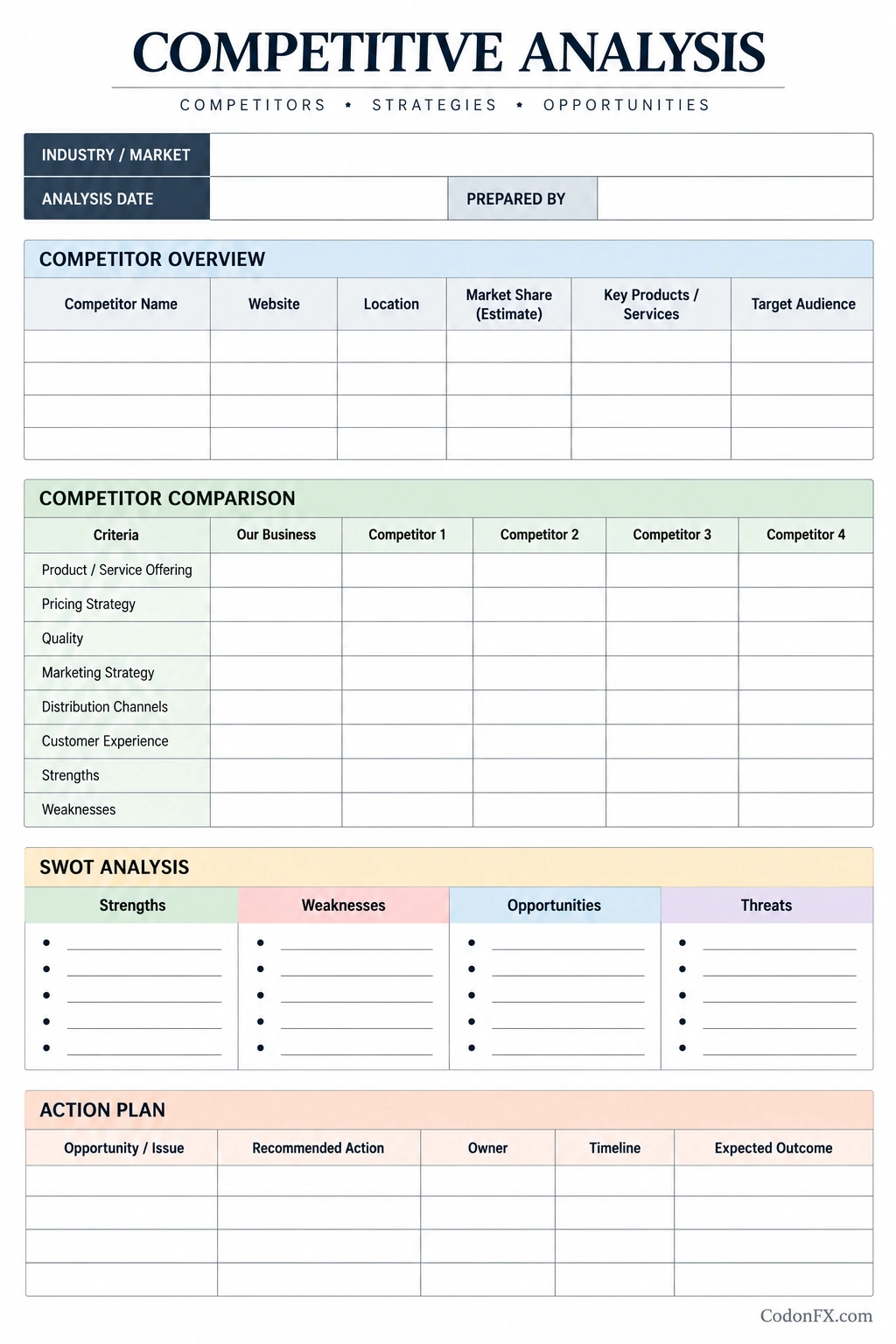
A competitive analysis template helps keep your research organized and makes comparisons easier to review. A practical worksheet can include the following sections.
- Market overview: Industry, target audience, research date, and analysis objectives.
- Competitor overview: Names, websites, locations, products, and target customers.
- Competitor comparison: Pricing, features, quality, marketing, distribution, and customer experience.
- SWOT analysis: Strengths, weaknesses, opportunities, and threats.
- Key findings: Important differences, customer needs, and market gaps.
- Action plan: Recommended actions, owners, timelines, and expected outcomes.
Keep the worksheet focused on information that supports your goals. A concise analysis with reliable evidence and clear recommendations is often more valuable than a lengthy report filled with irrelevant details.
Frequently Asked Questions About Competitive Analysis
What is the main purpose of competitive analysis?
The main purpose of competitive analysis is to understand how competing businesses operate and how your company compares with them. The findings help identify opportunities, improve positioning, evaluate risks, and make better strategic decisions.
What is included in a competitive analysis?
A competitive analysis commonly includes competitor profiles, product and service comparisons, pricing, target audiences, marketing strategies, customer experience, strengths, weaknesses, market opportunities, and recommended actions.
How many competitors should I analyze?
There is no fixed number. Start with a manageable group of the most relevant direct competitors, then add indirect or emerging competitors when they influence your market. The right number depends on your industry and research objectives.
What is the difference between competitive analysis and SWOT analysis?
Competitive analysis is the broader process of evaluating competitors and the market. SWOT analysis is a framework that organizes strengths, weaknesses, opportunities, and threats. SWOT can be one component of a competitive analysis.
How often should I conduct a competitive analysis?
Review your analysis whenever major market changes occur, such as new product launches, significant pricing changes, or shifts in customer behavior. Many businesses also benefit from scheduled reviews, with the frequency adjusted to how quickly their industry changes.
Can small businesses benefit from competitive analysis?
Yes. Small businesses can use competitor research to identify underserved customers, improve their value proposition, choose appropriate pricing, and focus limited resources on the most promising opportunities.
What tools can I use for competitive analysis?
You can start with a spreadsheet or printable competitive analysis template. Depending on your goals, you may also use website analytics, keyword research tools, social media research, customer surveys, review platforms, and publicly available industry reports.
What is the biggest mistake to avoid in competitive analysis?
A common mistake is copying competitors without understanding why their strategies work. Another is treating assumptions as facts. Use reliable evidence, consider your own customers and capabilities, and validate important opportunities before investing heavily.
Conclusion
Competitive analysis helps businesses understand their market position, evaluate competing offers, and identify opportunities for differentiation. By examining products, pricing, marketing, customer experience, and competitor strengths and weaknesses, you can make more informed strategic decisions.
Start by defining your objectives, selecting relevant competitors, and collecting reliable information. Use a comparison worksheet and SWOT analysis to organize your findings, then turn the most important insights into a measurable action plan.
Whether you are launching a new business, improving an existing product, or refining your marketing strategy, regular competitive analysis can help you respond to market changes and build a more sustainable competitive advantage.
Download: Competitive Analysis Template
