A Cleaning Agreement is a written contract between a client and a cleaning service provider that defines the terms and conditions of the cleaning services. It establishes clear expectations about the scope of work, service schedule, pricing, payment terms, responsibilities, and other important conditions before services begin.
Whether you operate a residential cleaning business, commercial cleaning company, housekeeping service, or specialized cleaning operation, a written agreement can make the relationship more organized and professional. For clients, it provides a clear understanding of what services they will receive and what they are expected to provide in return. For cleaning providers, it creates a documented framework for delivering services and managing changes or disagreements.
What Is a Cleaning Agreement?
A Cleaning Agreement is a formal document that outlines the relationship between a cleaning company or independent cleaner and a client. It describes what cleaning services will be provided, when they will be performed, how much they will cost, and what rules apply to the arrangement.
The agreement can be used for one-time cleaning services or recurring arrangements. It may apply to homes, offices, retail spaces, rental properties, commercial buildings, and other locations.
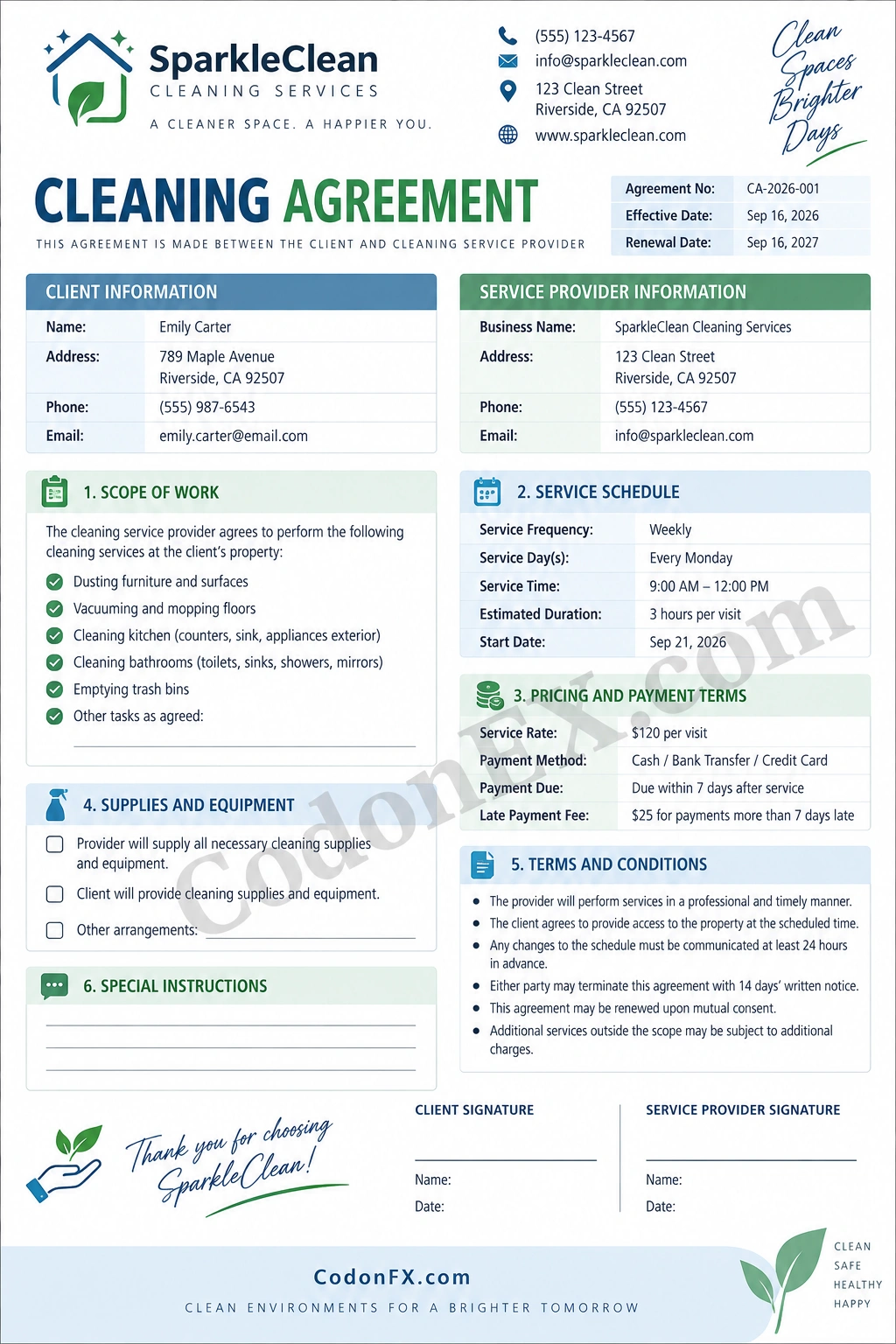
A typical cleaning service agreement may include:
- Client information: Name, address, phone number, and email address.
- Service provider information: Cleaning company or independent cleaner details.
- Scope of work: Specific cleaning tasks included in the service.
- Service schedule: Dates, frequency, arrival times, and estimated duration.
- Pricing: Service rates, recurring fees, or one-time charges.
- Payment terms: Payment methods, due dates, deposits, and applicable late fees.
- Supplies and equipment: Responsibility for providing cleaning products and equipment.
- Special instructions: Client preferences or property-specific requirements.
- Cancellation and termination: Rules for changing or ending the agreement.
- Signatures: Confirmation that both parties accept the stated terms.
Why Use a Cleaning Agreement?
A written cleaning contract helps both parties understand their responsibilities before work begins. Verbal arrangements can sometimes leave important details unclear, especially when services are provided regularly or involve multiple tasks.
A clear agreement can reduce confusion by documenting what was discussed and agreed upon. It also gives the cleaning business a professional framework for managing recurring services, pricing, scheduling, and client expectations.
Important benefits include:
- Clarifying the services included in the cleaning package.
- Documenting the agreed service schedule.
- Explaining pricing and payment expectations.
- Defining client and provider responsibilities.
- Reducing misunderstandings about additional services.
- Creating a written reference for future discussions.
- Providing a professional experience for clients.
- Establishing a framework for handling changes and cancellations.
What Should a Cleaning Agreement Include?
A well-prepared agreement should contain enough information for both parties to understand the arrangement without having to rely on separate conversations or assumptions.
Client and Cleaning Service Information
Start by identifying both parties. Include the client’s name and contact information along with the legal or business name and contact details of the cleaning provider.
For property-based services, include the address where cleaning will take place. If the provider manages multiple locations for the same client, list each relevant property or attach a separate service schedule.
Scope of Cleaning Services
The scope of work is one of the most important parts of the agreement. It should explain exactly what the cleaning provider agrees to do.
Common services may include dusting, vacuuming, mopping, bathroom cleaning, kitchen cleaning, surface cleaning, trash removal, and other agreed tasks.
For specialized services, describe the work in greater detail. For example, a deep-cleaning agreement may specify additional work such as cleaning inside appliances, detailed bathroom treatment, baseboard cleaning, or other intensive tasks.
Service Schedule
State when the services will be performed. A recurring cleaning arrangement might specify weekly, biweekly, or monthly visits. Include the expected service day, approximate arrival time, estimated duration, and start date when applicable.
A clearly documented schedule makes it easier for clients to prepare their property and for providers to manage their workload.
Pricing and Payment Terms
The agreement should clearly explain how the client will be charged. Cleaning businesses may use different pricing models depending on the type and frequency of service.
Flat-Rate Cleaning
A flat-rate arrangement charges a predetermined amount for a defined cleaning service. This approach can be convenient when the scope of work is clearly established.
Hourly Cleaning
Some cleaning providers charge an hourly rate. If this method is used, specify the hourly rate and explain whether there is a minimum number of hours per visit.
Recurring Service Pricing
Regular cleaning services may have weekly, biweekly, or monthly pricing. The agreement should state the applicable rate and when payment is due.
Payment terms can include:
- Accepted payment methods.
- Payment due date.
- Deposit requirements.
- Late payment policies.
- Cancellation charges, if applicable.
- Additional service charges.
Supplies and Cleaning Equipment
The agreement should clarify who is responsible for cleaning supplies and equipment. Some providers bring everything required for the service, while others use products and equipment supplied by the client.
If clients have preferences about certain products, those requirements can be documented in the agreement. For example, a client may request fragrance-free products or specify that particular surfaces should only be cleaned with approved products.
Clearly defining these responsibilities can prevent problems on the day of service.
Special Instructions and Property Access
Cleaning providers may need access to the client’s property at specific times. The agreement can explain how access will be provided through keys, access codes, building reception, or another approved method.
Special instructions should also be documented. These may include areas that should not be entered, fragile items requiring special care, pets, alarm systems, preferred products, or other property-specific considerations.
Clients should provide accurate information about conditions that could affect the cleaning work. Providers can then plan the service appropriately.
Cancellation and Rescheduling Policies
Recurring cleaning services can be affected by cancellations and schedule changes. A Cleaning Agreement should explain how much advance notice is expected when a client needs to cancel or reschedule.
The agreement may also explain whether a cancellation fee applies under specific circumstances. Any such terms should be clearly communicated and agreed upon before services begin.
For recurring arrangements, it can also be useful to explain how either party can terminate the ongoing service relationship and whether written notice is required.
Cleaning Agreement for Residential Services
A residential cleaning agreement is designed for homes, apartments, condominiums, and other private residences. It may cover routine housekeeping, deep cleaning, move-in cleaning, move-out cleaning, or other household services.
Residential agreements should clearly identify the areas and tasks included in each visit. If certain tasks are excluded, those exclusions can also be documented to avoid confusion.
For example, exterior window cleaning, carpet cleaning, heavy lifting, or specialized restoration work may require separate pricing and arrangements.
Cleaning Agreement for Commercial Services
Commercial cleaning agreements are often more detailed because they may cover larger properties and recurring services. Offices, retail locations, medical facilities, warehouses, and other commercial spaces can have different cleaning requirements.
A commercial agreement may specify cleaning frequencies, areas covered, employee responsibilities, security procedures, supply requirements, quality standards, and billing arrangements.
For larger contracts, the scope of work can be attached as a detailed schedule or service specification.
How to Create a Cleaning Agreement
1. Identify Both Parties
Write down the names and contact information of the client and cleaning provider. Use the correct business or legal name where appropriate.
2. Describe the Property
Identify the property or location where cleaning services will be performed. Include the complete service address and any relevant access information.
3. List the Services
Write a specific list of tasks included in the service. Avoid relying on vague descriptions such as “standard cleaning” when the client expects a detailed set of tasks.
4. Establish the Schedule
Specify the service frequency, preferred days, approximate time, start date, and expected duration when relevant.
5. Set the Price
Document the agreed price and explain how the amount is calculated. If additional services have separate rates, include those terms as well.
6. Define Responsibilities
Explain who supplies cleaning products, who provides equipment, how property access works, and what each party is responsible for during the service.
7. Add Terms and Conditions
Include relevant provisions for cancellations, rescheduling, additional work, payment delays, access, termination, and other operational matters.
8. Review and Sign
Both parties should review the agreement carefully before signing. Each party should retain a copy of the completed document for future reference.
Tips for Writing a Professional Cleaning Agreement
- Use clear language: Write terms that clients can easily understand.
- Be specific: List individual cleaning tasks instead of using overly broad descriptions.
- Define exclusions: Explain services that are not included in the standard price.
- Document additional charges: Explain when extra work may result in additional fees.
- Keep pricing transparent: State rates, payment dates, and applicable charges clearly.
- Update changes in writing: Document significant changes to the original arrangement.
- Use consistent terminology: Refer to the client and provider consistently throughout the document.
- Keep signed copies: Store completed agreements securely for future reference.
Common Mistakes to Avoid
One common mistake is creating an agreement that is too vague. A statement such as “clean the house” does not explain which rooms, surfaces, or tasks are included. More specific language can reduce misunderstandings.
Another mistake is failing to explain additional services. Clients may assume that every cleaning request is included in the standard rate. Clearly identifying optional or separately priced services can help prevent disagreements.
Businesses should also avoid changing important terms informally without documenting them. If the price, frequency, scope, or schedule changes substantially, updating the written agreement can help keep both parties aligned.
Using a Cleaning Agreement Template
A Cleaning Agreement Template provides a structured starting point for creating a professional service contract. Instead of building the document from scratch, a cleaning provider can fill in the relevant client information, cleaning tasks, schedule, pricing, payment terms, and other conditions.
A printable cleaning contract can be useful for independent cleaners, residential cleaning businesses, commercial cleaning companies, housekeeping services, and property service providers. Templates can also be adapted for one-time jobs or recurring service arrangements.
Before using a template, customize it to reflect the actual services and business practices involved. If the agreement contains legal provisions or is intended for a complex commercial relationship, consider obtaining appropriate professional legal advice about the applicable requirements in your jurisdiction.
Cleaning Agreement vs. Cleaning Service Quote
A cleaning service quote and a Cleaning Agreement serve different purposes. A quote generally communicates the expected price and scope of proposed services before the client accepts the offer.
An agreement goes further by documenting the terms of the service relationship. It may include scheduling, responsibilities, payment terms, cancellation rules, access arrangements, and other conditions.
In some businesses, the quote may become part of the final agreement or be referenced by it. The exact process depends on how the business structures its contracts and service procedures.
Frequently Asked Questions About Cleaning Agreements
What is a Cleaning Agreement used for?
A Cleaning Agreement is used to document the relationship between a client and cleaning service provider. It establishes the scope of work, schedule, pricing, payment terms, responsibilities, and other conditions of the cleaning service.
Should a cleaning service use a written contract?
A written agreement can provide clarity for both the client and provider by documenting what they have agreed to. The appropriate contract requirements can vary depending on the location, type of service, and circumstances.
What should be included in a residential cleaning contract?
A residential cleaning contract can include client and property information, cleaning tasks, service frequency, pricing, payment terms, supplies, access arrangements, cancellation policies, special instructions, and signatures.
Can a Cleaning Agreement be used for recurring services?
Yes. A Cleaning Agreement can be structured for weekly, biweekly, monthly, or other recurring cleaning arrangements. The schedule and pricing should be clearly stated.
Can the cleaning scope be changed after signing?
The scope can generally be changed if both parties agree to the change. Significant modifications should be documented clearly, particularly when they affect pricing, scheduling, or responsibilities.
Conclusion
A Cleaning Agreement provides a clear written framework for the relationship between a cleaning service provider and a client. By documenting the scope of work, schedule, pricing, payment terms, supplies, responsibilities, and other important conditions, the agreement helps establish shared expectations before services begin.
A well-organized agreement is useful for both residential and commercial cleaning services. Using a Cleaning Agreement Template can simplify the process by providing a professional structure that can be customized for different clients and service arrangements.
The most important goal is clarity. When both parties understand what will be done, when it will be done, how much it will cost, and what responsibilities each party has, the cleaning relationship can operate with fewer misunderstandings and a clearer framework for accountability.
