A cleaning services agreement is a legally binding contract that establishes clear expectations, duties, service details, and payment terms between a cleaning service provider and a client. Whether the services are provided for a home, office, rental property, or commercial building, a written agreement can help both parties understand exactly what is expected.
A well-prepared cleaning service contract can cover everything from the type and frequency of cleaning to pricing, responsibilities, cancellation policies, and termination terms. Putting these details in writing can reduce misunderstandings and provide a useful reference throughout the service relationship.
Using a cleaning services agreement template can make the process easier by providing a structured way to organize important information before both parties sign the agreement.
What Is a Cleaning Services Agreement?
A cleaning services agreement is a written contract between a cleaning company, independent cleaner, or cleaning service provider and a client. It describes the services that will be performed and establishes the terms under which those services will be provided.
The client may be a homeowner, landlord, tenant, business owner, property manager, or organization. The cleaning provider agrees to perform specific services in exchange for an agreed fee.
Depending on the arrangement, a cleaning agreement may be used for a one-time cleaning project or an ongoing service schedule such as weekly, biweekly, or monthly cleaning.
Why Use a Cleaning Services Agreement?
A verbal agreement may seem sufficient for a simple cleaning job, but written terms can provide greater clarity when the service involves recurring visits, multiple rooms, special requirements, or significant payment obligations.
A cleaning services agreement helps both parties understand their responsibilities before work begins. It can also provide a written record if questions or disagreements arise later.
- Clearly defines the cleaning services being provided.
- Establishes the service schedule and expected frequency.
- Documents the agreed cleaning service price.
- Explains payment methods and payment deadlines.
- Identifies the responsibilities of the client and service provider.
- Defines cancellation and termination procedures.
- Provides space for special instructions and additional terms.
Key Elements of a Cleaning Services Agreement
Although cleaning contracts can vary depending on the type of service, several important elements are commonly included in a well-organized agreement.
1. Parties and Contact Information
The agreement should identify the cleaning service provider and the client. Include names, business names when applicable, addresses, phone numbers, and email addresses.
Accurate contact information makes it easier for both parties to communicate about scheduling, changes, payments, or service-related concerns.
2. Service Location
Clearly identify the property where the cleaning services will take place. Include the complete address and, when useful, identify whether the property is residential, commercial, or another type of facility.
3. Scope of Cleaning Services
The scope of services is one of the most important parts of a cleaning services agreement. It should explain exactly what the provider has agreed to clean.
Depending on the arrangement, services may include:
- Dusting furniture and surfaces.
- Vacuuming carpets and rugs.
- Mopping floors.
- Cleaning bathrooms and fixtures.
- Cleaning kitchen surfaces.
- Emptying trash containers.
- Cleaning windows or glass surfaces.
- Changing linens when included.
- Deep cleaning specific areas.
- Other specially requested cleaning tasks.
Specific descriptions are preferable to vague statements such as “general cleaning.” Clearly listing the work can help prevent disagreements about what is and is not included.
4. Cleaning Schedule
The agreement should state when and how frequently the services will be performed. Common arrangements include one-time, weekly, biweekly, and monthly cleaning.
The contract can also specify the expected arrival time, estimated service duration, or procedures for changing a scheduled appointment.
5. Cleaning Service Fees
The agreement should clearly state how much the client will pay for the services. The fee may be calculated per visit, per hour, per project, or according to another pricing arrangement.
If additional services have separate charges, those fees should also be explained. Clear pricing helps both parties understand the financial terms before the work begins.
6. Payment Terms
Payment terms should explain when payment is due and which payment methods are accepted. For recurring cleaning services, the agreement may establish weekly or monthly payment arrangements.
If late payments, deposits, cancellation charges, or additional service fees apply, those terms should be written clearly in the agreement.
Client Responsibilities
A cleaning service agreement can also establish responsibilities for the client. The exact responsibilities will depend on the property and the services being provided.
- Provide reasonable access to the property at the scheduled time.
- Communicate special cleaning instructions before the service begins.
- Inform the provider about areas that require special care.
- Secure valuable or sensitive personal belongings when appropriate.
- Inform the provider about pets or other relevant property conditions.
- Make payments according to the agreed schedule.
- Notify the provider promptly about service concerns.
Cleaning Service Provider Responsibilities
The agreement should also explain what the cleaning service provider is expected to do. This creates a clear standard for the services being delivered.
- Perform the agreed cleaning services professionally.
- Follow the cleaning schedule established in the agreement.
- Use appropriate cleaning products and equipment.
- Follow reasonable instructions regarding the property.
- Take reasonable care of the client’s property.
- Communicate promptly about scheduling issues or unexpected problems.
- Report significant damage or unusual conditions when discovered.
Cleaning Services Agreement for Residential Properties
Residential cleaning agreements are commonly used between homeowners, tenants, landlords, and professional cleaners. The contract can specify which rooms are included and which cleaning tasks should be performed during each visit.
For example, a recurring residential agreement might include kitchens, bathrooms, bedrooms, living areas, and common spaces. Deep cleaning tasks may be listed separately if they are not included in the regular service.
A residential cleaning contract can also address issues such as pets, access to the property, keys, alarm systems, preferred cleaning products, and areas that should not be entered.
Cleaning Services Agreement for Commercial Properties
Commercial cleaning agreements may require more detailed terms because offices, retail spaces, warehouses, medical facilities, and other properties can have different cleaning requirements.
A commercial agreement may identify specific areas, cleaning frequencies, sanitation requirements, operating hours, security procedures, supplies, and responsibilities for reporting maintenance issues.
For larger properties, the contract may also include a separate cleaning checklist or service schedule that defines tasks by room, area, or frequency.
One-Time vs. Recurring Cleaning Services
One-Time Cleaning Agreement
A one-time cleaning agreement is appropriate when the provider is hired for a single service. This might include move-out cleaning, post-event cleaning, spring cleaning, or preparation for a property showing.
The agreement should identify the service date, scope of work, price, and any special requirements.
Recurring Cleaning Agreement
A recurring cleaning agreement establishes an ongoing relationship. It should clearly state the frequency of service and explain how future appointments, cancellations, price changes, and termination will be handled.
For recurring services, documenting the regular cleaning schedule is particularly useful because both parties can refer to the agreement instead of relying on informal messages or verbal arrangements.
Cancellation and Termination Terms
A cleaning services agreement should explain how either party can cancel or terminate the arrangement. This is especially important for recurring services.
The contract may specify how much advance notice is required, whether cancellation fees apply, and what happens to scheduled services after termination notice is provided.
Clear termination terms help both parties understand how the business relationship can end without unnecessary confusion.
How to Create a Cleaning Services Agreement
Creating a cleaning contract does not have to be complicated. Start by identifying the parties and then work through each major service term.
- Identify the parties: Record the legal names and contact information of the client and provider.
- Define the property: Include the complete service address.
- List the services: Describe the cleaning tasks and areas covered.
- Set the schedule: State the service frequency, dates, and preferred times.
- Establish pricing: Specify the service fee and any additional charges.
- Explain payment terms: Include payment methods and due dates.
- Define responsibilities: State what the client and provider are expected to do.
- Address cancellations: Explain notice requirements and applicable fees.
- Add special terms: Include property-specific instructions or requirements.
- Review and sign: Both parties should review the agreement before signing.
Tips for Writing a Clear Cleaning Contract
A good cleaning service contract should be easy to understand. Avoid unnecessary legal language when simple wording can communicate the same requirement more clearly.
- Be specific about which cleaning tasks are included.
- Separate standard services from optional or additional services.
- Write prices and payment deadlines clearly.
- Document the frequency and expected schedule.
- Explain how changes to the service arrangement will be handled.
- Include a section for special instructions.
- Make sure both parties receive a copy of the signed agreement.
Common Mistakes to Avoid
Several common mistakes can make a cleaning agreement less useful. One of the biggest is failing to define the scope of work in enough detail.
Another common issue is leaving payment terms unclear. The agreement should state the price, when payment is due, and whether additional services may result in additional charges.
It is also useful to avoid relying entirely on informal text messages or verbal conversations for important changes. Significant changes to the service arrangement should be documented in writing.
Using a Cleaning Services Agreement Template
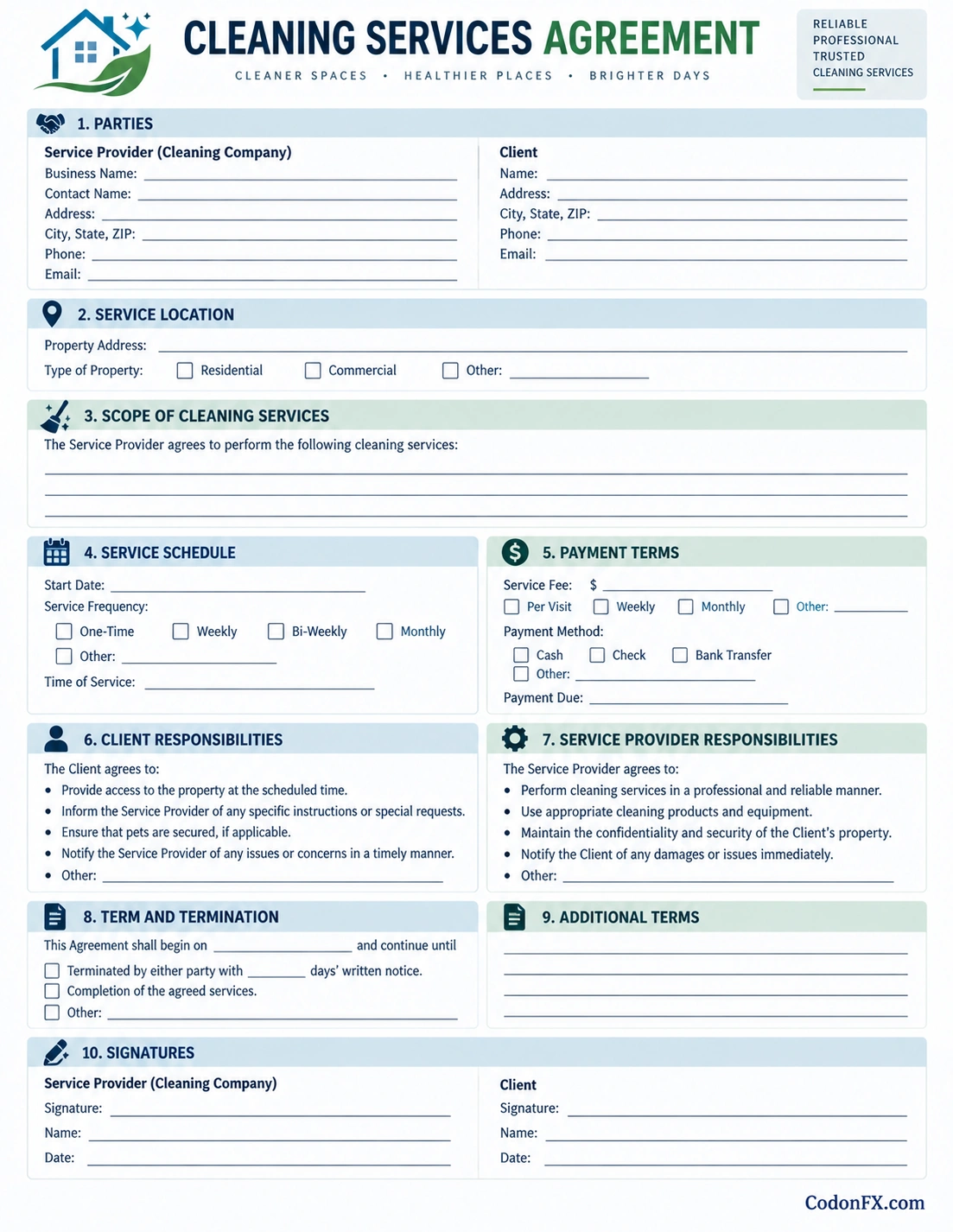
A cleaning services agreement template provides a practical starting point for organizing the essential terms of a cleaning arrangement. Instead of creating the document from scratch, users can fill in the relevant information and customize the sections according to their needs.
A printable template can include areas for the parties, property address, cleaning scope, schedule, payment terms, responsibilities, termination conditions, additional terms, and signatures.
Templates should be reviewed and customized rather than treated as a substitute for professional legal advice. Contract requirements can vary depending on the location, type of service, and specific circumstances.
Final Thoughts
A cleaning services agreement provides a structured way for cleaning providers and clients to document their expectations before services begin. By clearly defining the cleaning scope, schedule, pricing, payment terms, responsibilities, and termination procedures, the agreement can help create a more organized service relationship.
Whether you need a contract for residential cleaning, commercial cleaning, a one-time project, or recurring services, a clear written agreement gives both parties a useful reference. A well-organized cleaning services agreement template can make the preparation process faster while helping ensure that important details are not overlooked.
Download: Cleaning Service Agreement Template
