Every business decision involves weighing potential benefits against the resources required to achieve them. Whether an organization is considering a new project, purchasing equipment, launching a product, or expanding its operations, understanding the financial impact is essential. A cost-benefit analysis provides a practical way to evaluate these decisions before committing time and money.
By comparing the expected costs of an initiative with its potential financial benefits, businesses can determine whether a project is economically worthwhile. This approach also helps managers identify risks, compare alternatives, and allocate resources more effectively.
Whether you are evaluating a small business investment or a large organizational project, learning how to perform a cost-benefit analysis can support better financial planning. This guide explains the process, key calculations, practical examples, and how to use a printable cost-benefit analysis template.
What Is a Cost-Benefit Analysis?
A cost-benefit analysis (CBA) is a financial evaluation method used to compare the expected costs of a decision, project, or investment with its anticipated benefits. Its purpose is to determine whether the value generated by an initiative justifies the resources required to complete it.
Costs may include initial investments, labor, materials, maintenance, training, and ongoing operating expenses. Benefits may include additional revenue, reduced expenses, improved productivity, time savings, and other measurable economic advantages.
By converting relevant costs and benefits into monetary values where possible, decision-makers can evaluate different options using a consistent financial framework.
For example, a company considering new software may compare the purchase price, implementation expenses, and training costs against expected improvements in productivity and reductions in administrative expenses.
If the estimated benefits exceed the total costs, the investment may be financially attractive. However, decision-makers should also consider uncertainty, timing, risks, and nonfinancial factors before making a final decision.
Why Is Cost-Benefit Analysis Important?
A cost-benefit analysis helps organizations make informed decisions by showing the potential financial advantages and disadvantages of an initiative. It provides a structured way to evaluate opportunities instead of relying entirely on assumptions or intuition.
1. Supports Better Business Decisions
Businesses frequently face decisions involving competing projects and limited resources. A cost-benefit analysis provides financial information that helps managers determine which opportunities offer the greatest potential value.
2. Improves Resource Allocation
Organizations cannot always fund every proposed initiative. Comparing expected costs and benefits helps decision-makers prioritize projects that align with their financial objectives and available budgets.
3. Identifies Potential Financial Risks
Evaluating expenses before starting a project helps organizations recognize possible financial challenges. These may include unexpected operating costs, implementation delays, maintenance expenses, or lower-than-expected revenue.
4. Measures Potential Profitability
Comparing expected benefits with total costs helps businesses estimate whether an investment could generate a positive financial return. This information supports budgeting, investment planning, and long-term financial decisions.
5. Makes Project Comparisons Easier
When several projects are being considered, a consistent evaluation method makes it easier to compare their financial outcomes. Decision-makers can identify which option provides the strongest expected economic value.
Key Components of a Cost-Benefit Analysis
A reliable cost-benefit analysis requires a clear understanding of the expenses and benefits associated with a proposed decision. The following components provide a useful starting point.
1. Direct Costs
Direct costs are expenses directly associated with completing a project or delivering a product. They are generally easier to identify and measure.
Examples include:
- Equipment and machinery purchases.
- Employee wages and project labor.
- Raw materials and supplies.
- Software licenses and subscriptions.
- Contractor and professional service fees.
2. Indirect Costs
Indirect costs support the project but are not always directly attributable to a single activity. These expenses should also be considered because they affect the overall financial commitment.
Examples include office expenses, administrative support, utilities, management time, and shared operational resources.
3. Tangible Benefits
Tangible benefits are measurable financial advantages that can generally be expressed in monetary terms.
Examples include:
- Increased sales revenue.
- Reduced operating expenses.
- Lower production costs.
- Improved employee productivity.
- Reduced equipment maintenance costs.
4. Intangible Benefits
Intangible benefits are valuable outcomes that are difficult to measure precisely in monetary terms. Although they may not appear directly in financial calculations, they can influence the success of a project.
Examples include improved customer satisfaction, stronger brand reputation, better employee morale, improved workplace safety, and enhanced customer experience.
5. Opportunity Costs
Opportunity costs represent the potential value of an alternative that an organization gives up when choosing one option over another.
For example, investing in new manufacturing equipment may prevent a company from using the same budget to expand its marketing activities. Considering opportunity costs helps decision-makers evaluate the broader impact of their choices.
How to Perform a Cost-Benefit Analysis
Performing a cost-benefit analysis involves identifying the proposed initiative, estimating its costs and benefits, and comparing the results. Following a structured process can make the evaluation more consistent and useful.
Step 1: Define the Project or Decision
Start by clearly explaining what you want to evaluate. Identify the project’s objectives, expected outcomes, and the business problem it is intended to solve.
For example, a company may want to determine whether purchasing automated equipment will reduce production expenses and improve manufacturing efficiency.
Step 2: Identify All Relevant Costs
List every significant expense associated with the project. Include both initial investment costs and ongoing expenses throughout the evaluation period.
Consider the following categories:
- Initial purchase or implementation costs.
- Labor and training expenses.
- Operating and maintenance costs.
- Administrative and overhead expenses.
- Additional costs caused by potential delays or risks.
Using realistic estimates is important. Missing expenses can make a project appear more financially attractive than it actually is.
Step 3: Estimate the Expected Benefits
Identify the financial and operational advantages the project may generate. Whenever possible, assign a monetary value to each measurable benefit.
For example, a new software system may reduce administrative labor costs by $12,000 annually. If the improvement is supported by reasonable assumptions, this amount can be included in the estimated benefits.
Also document intangible benefits separately when they cannot be reliably converted into monetary values.
Step 4: Determine the Evaluation Period
Choose a suitable period for measuring the project’s expected costs and benefits. The timeframe may depend on the project’s expected useful life, investment size, and business objectives.
A short-term project may require a monthly or annual evaluation, while equipment purchases and infrastructure investments may require several years of analysis.
Step 5: Calculate Total Costs and Benefits
Add the estimated expenses to determine the total project costs. Then calculate the combined value of the expected financial benefits over the same evaluation period.
Make sure the calculations use consistent timeframes and monetary assumptions.
Step 6: Calculate Net Benefits and the Benefit-Cost Ratio
Once the totals are available, compare the expected benefits with the estimated costs using standard financial formulas.
Net Benefit = Total Benefits – Total Costs
Benefit-Cost Ratio (BCR) = Total Benefits ÷ Total Costs
A positive net benefit indicates that estimated benefits exceed estimated costs. A benefit-cost ratio greater than 1 indicates that the expected benefits are higher than the costs.
Step 7: Evaluate the Results and Make a Decision
Review the calculations and consider whether the project meets the organization’s financial objectives. Examine potential risks, alternative investments, and nonfinancial factors before approving the initiative.
The final recommendation may be to proceed, reject the proposal, or conduct further analysis before making a decision.
Cost-Benefit Analysis Formulas
Several financial measurements can help decision-makers understand the results of a cost-benefit analysis. Three commonly used calculations are net benefit, benefit-cost ratio, and return on investment.
1. Net Benefit Formula
Net benefit measures the difference between total expected benefits and total estimated costs.
Formula: Net Benefit = Total Benefits – Total Costs
For example, if a project generates $80,000 in expected benefits and requires $50,000 in total costs, the net benefit is $30,000.
2. Benefit-Cost Ratio Formula
The benefit-cost ratio measures how much expected benefit is generated for every dollar spent.
Formula: BCR = Total Benefits ÷ Total Costs
Using the previous example, the calculation is $80,000 ÷ $50,000 = 1.6. This means the project is expected to generate $1.60 in benefits for every $1.00 in costs.
A ratio above 1 generally indicates that the expected benefits exceed the costs. A ratio below 1 suggests that the costs are greater than the expected benefits.
3. Return on Investment Formula
Return on investment (ROI) expresses the net gain relative to the total investment as a percentage.
Formula: ROI = (Net Benefit ÷ Total Costs) × 100%
Based on the example above, the ROI is ($30,000 ÷ $50,000) × 100% = 60%.
These calculations are useful for initial comparisons. However, projects with benefits and costs occurring over multiple years may require additional methods, such as net present value (NPV), to account for the time value of money.
Cost-Benefit Analysis Example
Consider a small business evaluating whether to purchase new equipment to improve its production process. Management estimates that the equipment will cost $30,000 and generate $48,000 in financial benefits over the evaluation period.
The simplified analysis would look like this:
- Equipment purchase and implementation: $25,000.
- Training and installation: $5,000.
- Total Costs: $30,000.
- Increased production revenue: $35,000.
- Reduced operating expenses: $13,000.
- Total Benefits: $48,000.
The financial results are:
- Net Benefit: $48,000 – $30,000 = $18,000.
- Benefit-Cost Ratio: $48,000 ÷ $30,000 = 1.6.
- ROI: ($18,000 ÷ $30,000) × 100% = 60%.
Based on these estimates, the equipment purchase appears financially attractive because the expected benefits exceed the total costs. However, management should verify the assumptions, consider ongoing expenses, and evaluate potential risks before making a final decision.
Cost-Benefit Analysis Template
A cost-benefit analysis template provides a structured way to organize financial information and evaluate a proposed project. Instead of creating a worksheet from scratch, you can use a prepared layout to record estimated expenses, expected benefits, and financial results.
A practical worksheet should include the following sections:
- Project Overview: Project name, objective, analysis date, and evaluation period.
- Total Costs: Individual expenses and estimated amounts.
- Total Benefits: Expected financial benefits and their estimated values.
- Analysis Summary: Net benefit, benefit-cost ratio, and return on investment.
- Final Recommendation: Proceed, do not proceed, or conduct further review.
The following printable cost-benefit analysis template provides a simple worksheet for organizing these details and documenting your financial evaluation.
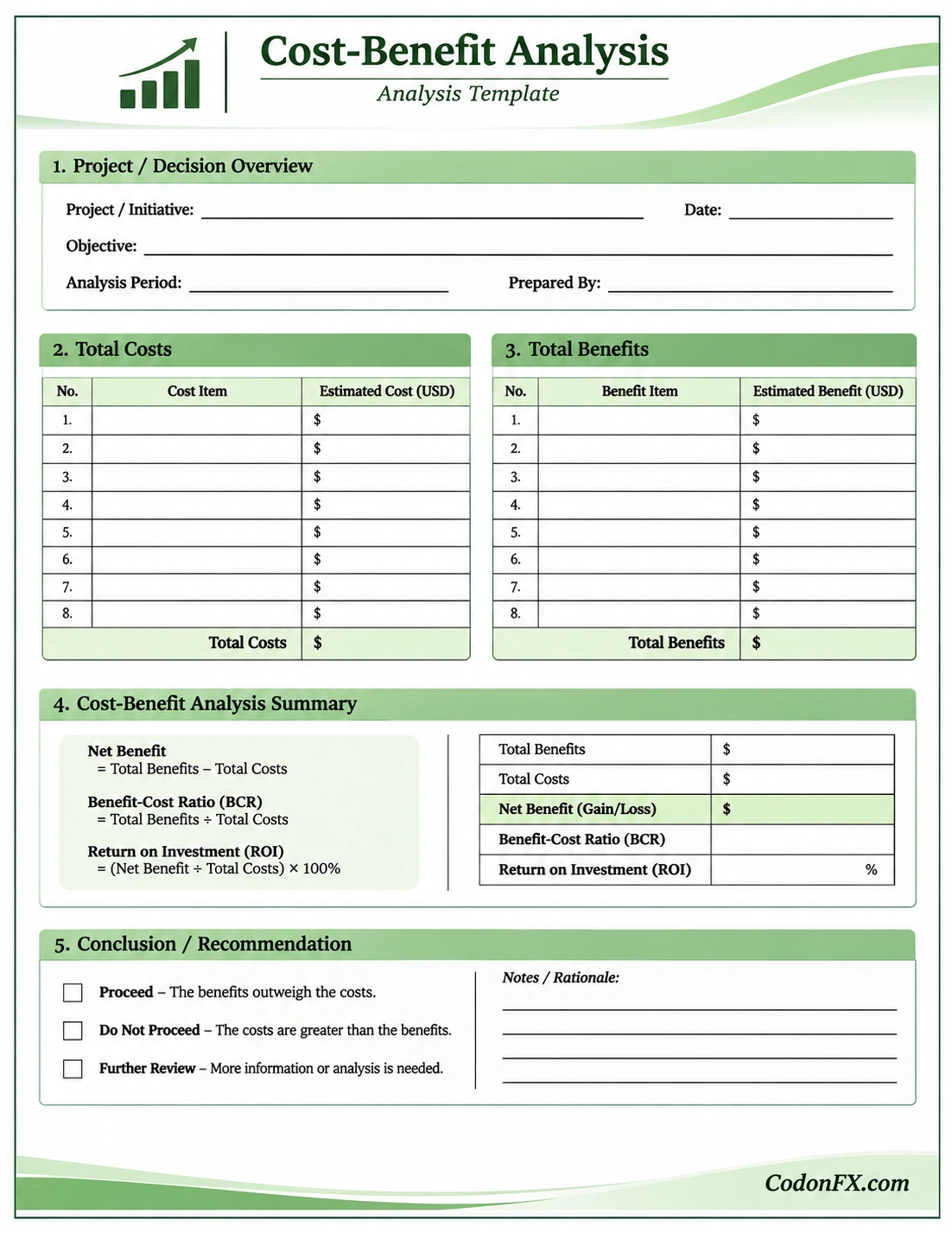
You can use this worksheet for business projects, operational improvements, equipment purchases, investment decisions, and other financial evaluations. Enter realistic estimates and adjust the evaluation period to match your project.
The worksheet is designed for preliminary analysis. More complex projects may require additional calculations, discounted cash flows, sensitivity analysis, and professional financial review.
Common Mistakes to Avoid in Cost-Benefit Analysis
Even a well-organized financial evaluation can produce misleading results if important information is overlooked. Avoid these common mistakes when preparing your analysis.
Ignoring Hidden Costs
Some projects involve expenses beyond the initial purchase price. Maintenance, training, administrative support, and future upgrades should be included whenever relevant.
Overestimating Expected Benefits
Using unrealistic revenue projections or assuming that every expected improvement will occur can distort the results. Base estimates on available data, historical performance, and reasonable assumptions.
Using Different Evaluation Periods
Comparing costs over one year with benefits over five years can produce an inaccurate conclusion. Use consistent timeframes when comparing financial values.
Ignoring Nonfinancial Factors
Some benefits and risks cannot be measured easily in dollars. Customer satisfaction, employee well-being, environmental impact, and regulatory compliance may also influence the final decision.
Failing to Consider Uncertainty
Project estimates are not guaranteed outcomes. Consider alternative scenarios to understand how changes in costs, revenue, or project timing could affect the results.
Frequently Asked Questions
What is the main purpose of a cost-benefit analysis?
The main purpose is to determine whether the expected benefits of a project or decision outweigh its costs. It helps organizations evaluate financial feasibility, compare alternatives, and make more informed decisions.
What are the five steps of cost-benefit analysis?
A simplified five-step process includes defining the project, identifying costs, estimating benefits, calculating financial results, and evaluating the findings to make a recommendation. More detailed analyses may include additional steps for risk assessment and discounting future cash flows.
What is a good benefit-cost ratio?
A benefit-cost ratio greater than 1 generally indicates that expected benefits exceed estimated costs. However, a higher ratio does not automatically mean a project is the best investment. Decision-makers should also consider project size, risk, timing, and strategic objectives.
What is the difference between cost-benefit analysis and ROI?
Cost-benefit analysis is a broader evaluation method that compares the expected costs and benefits of a decision. ROI is a specific financial metric that measures net gains relative to the investment cost as a percentage.
When should a business use cost-benefit analysis?
Businesses can use cost-benefit analysis before making decisions involving equipment purchases, software implementation, marketing campaigns, hiring, expansion, operational improvements, and other significant investments.
Can cost-benefit analysis include intangible benefits?
Yes. Intangible benefits such as improved customer satisfaction, employee morale, and brand reputation should be considered. When reliable monetary estimates are unavailable, these benefits can be documented separately rather than assigned arbitrary financial values.
What is the difference between cost-benefit analysis and cost-effectiveness analysis?
Cost-benefit analysis expresses both costs and benefits in monetary terms when possible. Cost-effectiveness analysis compares the costs of different options against a common outcome, such as the cost per unit of output or improvement achieved.
Is a cost-benefit analysis template useful for small businesses?
Yes. A simple template helps small businesses organize project expenses, estimate financial benefits, calculate net value, and compare investment opportunities without building a complicated financial model.
Conclusion
A cost-benefit analysis is a valuable decision-making tool that helps businesses and organizations evaluate whether a proposed project or investment is financially worthwhile. By comparing expected expenses with potential benefits, decision-makers can better understand the economic value of an initiative.
A reliable analysis should include direct and indirect costs, measurable benefits, relevant risks, and an appropriate evaluation period. Calculations such as net benefit, benefit-cost ratio, and return on investment can provide useful insights into the potential financial outcome.
Whether you are evaluating a business expansion, purchasing equipment, or improving operational processes, a structured cost-benefit analysis can support smarter resource allocation and more informed decisions. Use a cost-benefit analysis template to organize your calculations, document your assumptions, and select opportunities that align with your organization’s long-term goals.
Download: Cost-Benefit Analysis Template
